
Introducing Engine V4 — From 9 Models to 15 Signals
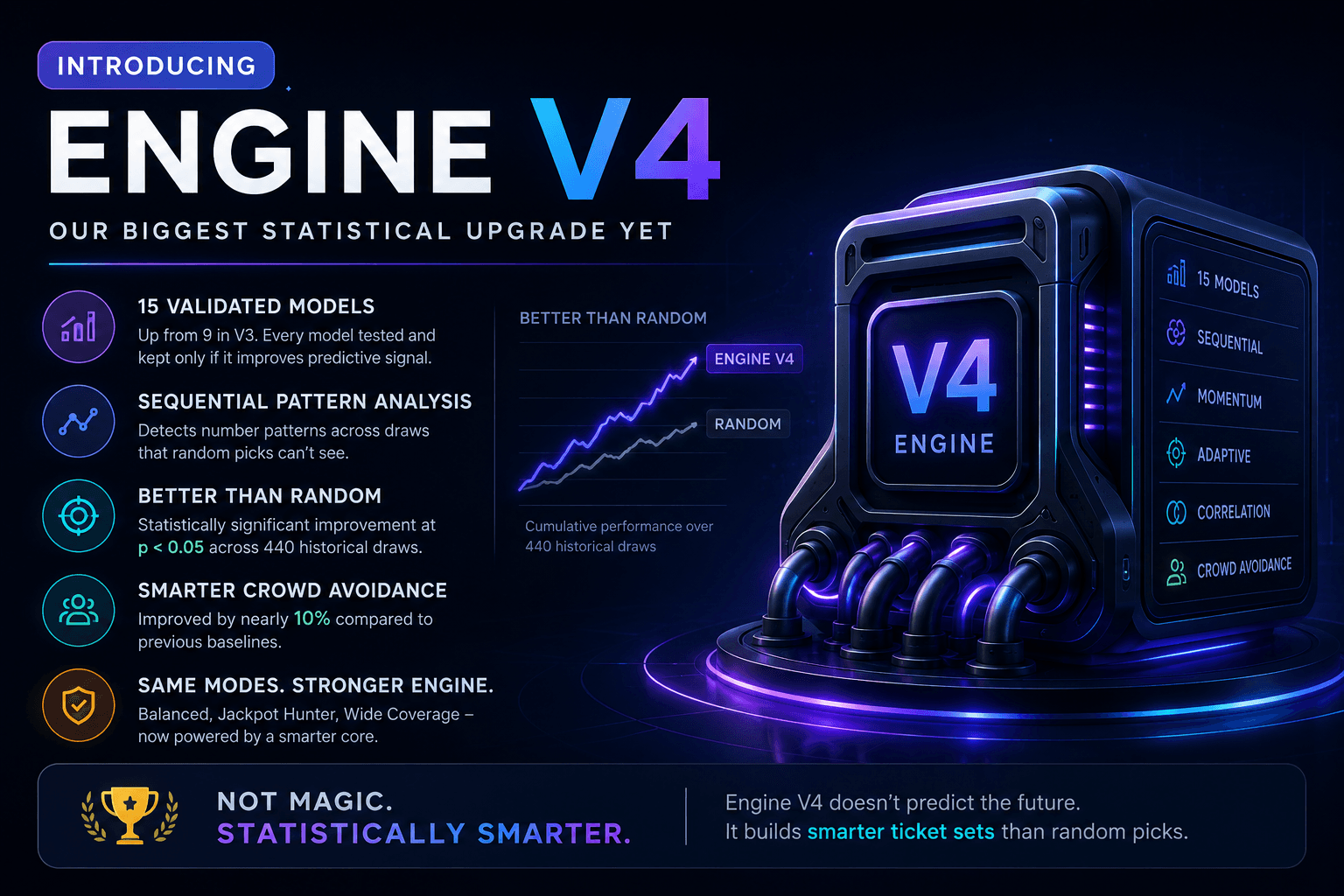
Introducing Engine V4 — From 9 Models to 15 Signals
By Chronos Team • Mar 2026 • 6 min read
We’re excited to introduce Engine V4, the newest generation of our EuroJackpot analysis engine.
This is not just another update.
Engine V4 is the first version built around a simple rule:
The combined engine is measured against real historical data, and we publish what that measurement shows.
That means V4 is not based only on statistical ideas. The combined engine is replayed against hundreds of real EuroJackpot draws, and the current results are published on the methodology page.
From 9 Models to 15 Signals
Engine V3 used 9 statistical models.
Engine V4 now uses 15 statistical models, equally weighted.
But the change is not just the number of models.
Each signal describes a different property of the draw history. The historical replay measures the engine as a whole; the combined engine showed no reliable predictive advantage over random selection.
The model set was chosen in May 2026. The replay result recorded then was later nearly reproduced, but only with a test setup that mixed EuroJackpot and EuroMillions draw history, which production does not use; the current figures are below.
In other words:
V4 became broader, not simply more complicated.
A New Area: Sequential Patterns
The largest change in V4 came from a completely new area of analysis:
Sequential draw-to-draw pattern detection.
Most lottery tools only analyze static statistics such as hot numbers, cold numbers, or frequency tables.
V4 goes further.
It looks at which numbers followed which in past draws over short windows of time.
This lets the engine score numbers by which numbers tended to follow others in the history. The published replay evaluates the combined engine; it does not isolate the contribution of this signal.
That became the foundation of the new V4 signal architecture.
Measured Against Random — What the Replay Shows
Engine V4 was replayed across 440 historical EuroJackpot draws (28 June 2022 – 11 September 2026), scoring each draw with only the draws before it.
The result:
The drawn numbers sat at a mean rank of 25.19 in the engine's scoring, against a theoretical expectation of 25.5 for random selection.
In the corrected seeded run of 21 September 2026, balanced 12-ticket engine sets matched approximately 0.51 main numbers per ticket, compared with 0.50 for simulated random sets; the difference was not statistically significant. That average is a description of the replay, not a win probability.
For non-statistical readers, this means:
This historical backtest detected no reliable predictive advantage over random selection.
An earlier version of this article reported a statistically significant advantage. We later nearly reproduced that result, but only with a test setup that mixed EuroJackpot and EuroMillions draw history, which production does not use. It does not establish a predictive advantage for the production engine, and the claim remains withdrawn.
What the Engine Does Instead
Lottery prediction is not about magic formulas or guaranteed wins.
No honest system can promise that.
What the engine offers is a repeatable, inspectable way to build a ticket set and to review it after the draw.
The figures behind this statement are published on the methodology page.
That is what V4 is built to do.
New Signals Inside V4
Engine V4 introduces several signals that were not part of V3:
- Sequential draw pattern analysis
- EMA momentum crossover signals
- Adaptive recency weighting
- Main-number and Euro-number correlation models
- Equal-weight blending of the 15 signals
- A fixed pattern heuristic for common picking habits
Together, these models produce one ranking of the numbers; the set is then built from that ranking with structural rules and a limit on how many numbers two lines may share.
The Pattern Heuristic
V4 also scores each candidate line with a fixed pattern heuristic.
Many players unknowingly choose similar number combinations.
That creates a hidden problem:
If those combinations win, jackpots are often heavily shared.
The heuristic looks for five patterns people are often said to pick — numbers in the 1–31 birthday range, consecutive numbers, multiples of five, a short list of popular numbers, and evenly spaced lines — and lowers the score of lines that show them. It uses no data about what other players actually play.
In the historical replay, engine sets scored 0.40 on this heuristic against 0.41 for simulated random sets — a small difference on an internal heuristic that uses no player data, so no reduction in prize sharing is claimed.
We therefore make no claim about sharing prizes with fewer other winners.
The Same Modes — A Different Core
The overall experience remains familiar.
You can still choose between:
- Balanced
- Jackpot Hunter
- Wide Coverage
Each mode changes only how the set is built from the same ranking.
Balanced uses a medium candidate pool and requires at least two different numbers between any two lines.
Jackpot Hunter uses a narrower pool and weights the line scores highest.
Wide Coverage uses a wider pool and requires at least three different numbers between any two lines.
The modes stayed simple.
The scoring behind them changed.
What This Means for Your Tickets
With Engine V4, every generated ticket set is built with:
- more statistical models
- sequential pattern analysis
- equal-weight signal blending
- a Monte Carlo ticket-set search
- a diversity constraint between tickets
- a fixed popularity heuristic (no player data)
- structural filters on every ticket
The result is a more structured way to build a ticket set than picking lines one by one.
Not a guarantee.
And not a measured advantage over random selection either — the replay found none.
Our Philosophy Remains the Same
Lottery outcomes are still unpredictable.
Engine V4 does not promise jackpots.
What it does provide is something much more realistic:
a repeatable system for building ticket sets that you can save and review after every draw.
That is the foundation of our engine.
Less guessing about what you played. More structure you can check.
Engine V4 is now live.
Try the new engine on the AI Picks page and experience the next generation of statistical ticket generation.
Try V4 engine now
Discover data-driven predictions and strategies