
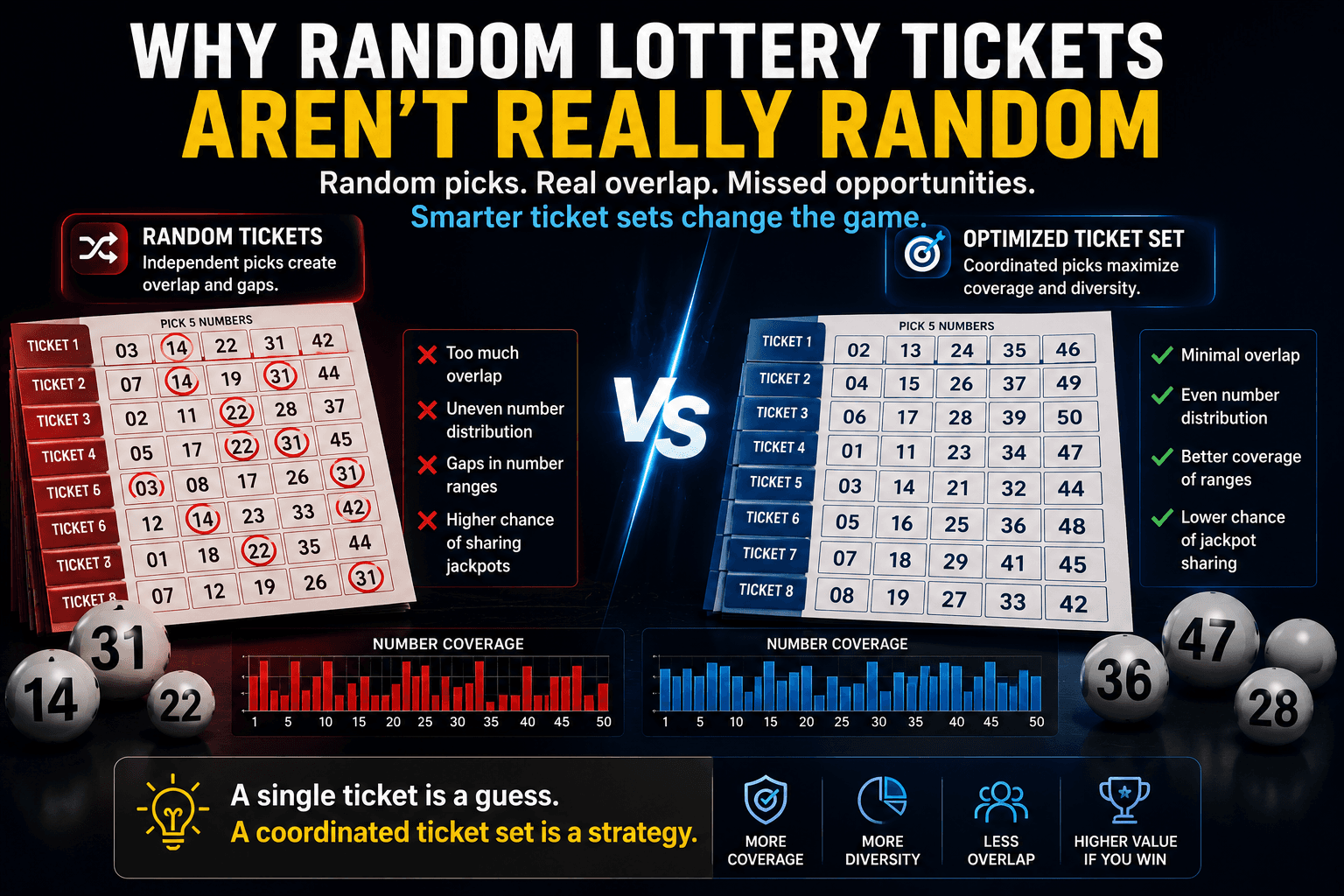
Many lottery players believe random tickets are the gold standard.
After all, lottery draws are random.
So shouldn't random ticket selection be the optimal strategy?
At first glance, the logic seems sound.
But there is an important difference between a random draw and a random ticket set.
And understanding that difference may completely change how you think about lottery strategy.
What Is A Random Lottery Ticket?
A random lottery ticket is exactly what it sounds like.
The numbers are selected without any deliberate strategy.
This can happen through:
- Quick Picks generated by a lottery terminal
- Random number generators
- Manual random selection
Most players assume this approach guarantees a fair and unbiased ticket.
For a single ticket, that's largely true.
The problem begins when you play multiple tickets.
The Hidden Problem With Multiple Random Tickets
Imagine you buy eight random tickets.
You might expect them to cover a large portion of the available number space.
But randomness doesn't work that way.
Random systems naturally create:
- Clusters
- Repetition
- Overlap
- Gaps
You may find the same number appearing on several tickets.
You may discover entire ranges of numbers that never appear at all.
The result is often much less efficient than players expect.
Random Does Not Mean Optimized
Many people use the words "random" and "optimal" interchangeably.
They're not the same thing.
Consider throwing darts at a wall.
A random pattern might leave large empty spaces.
A carefully designed pattern would spread coverage evenly across the entire target.
Lottery ticket sets behave similarly.
Random selection creates unpredictability.
Optimization creates efficiency.
Those are very different goals.
Why Quick Picks Often Overlap
Quick Picks are designed to generate valid lottery entries quickly.
They are not designed to coordinate with your previous tickets.
Each ticket is generated independently.
The system does not ask:
- Which numbers have already been selected?
- Which ranges are underrepresented?
- Which combinations create the best coverage?
As a result, overlap naturally occurs.
Even though every ticket is random, the overall ticket set may be surprisingly inefficient.
The Coverage Problem
Let's imagine two players.
Player A buys eight completely random tickets.
Player B buys eight tickets designed to complement each other.
Both players spend the same amount of money.
The difference is how their tickets work together.
Player B's tickets may:
- Cover more unique numbers
- Reduce duplication
- Increase diversification
- Spread selections across more combinations
The objective isn't predicting winning numbers.
It's improving coverage of the available number space.
Why Humans Aren't Good At Randomness Either
Many players avoid Quick Picks and create their own "random" tickets.
Unfortunately, humans are surprisingly poor random number generators.
Studies consistently show that people tend to prefer:
- Middle numbers
- Visually balanced patterns
- Familiar dates
- Symmetrical arrangements
- Lucky numbers
As a result, human-generated tickets are often less random than players believe.
This is one reason certain combinations become extremely popular.
The Jackpot Sharing Problem
Random selection creates another hidden challenge.
It doesn't account for what other players are doing.
Imagine two winning tickets:
Ticket A:
1, 2, 3, 4, 5
Ticket B:
7, 18, 29, 34, 46
Both tickets have exactly the same chance of winning.
However, Ticket A is dramatically more likely to be shared with other winners because it follows a highly recognizable pattern.
Many modern lottery systems therefore consider crowd behavior alongside statistical signals.
The goal isn't simply winning.
It's maximizing the value of a win if it happens.
What Modern Lottery Optimization Actually Does
Optimization isn't about predicting the future.
It's about building stronger ticket sets.
Instead of generating tickets independently, the system evaluates them as a group.
Questions include:
- How much overlap exists?
- How many unique numbers are covered?
- How balanced is the distribution?
- How likely are players to choose similar combinations?
The result is a coordinated set rather than a collection of isolated guesses.
Why Random Still Matters
This doesn't mean randomness is bad.
In fact, randomness remains an important ingredient.
A good lottery model should avoid becoming overly predictable.
Many advanced systems include controlled randomness specifically to prevent overfitting and excessive concentration around historical patterns.
The key is balance.
Randomness provides diversity.
Optimization provides structure.
Together they often create stronger ticket sets than either approach alone.
Final Thoughts
Random lottery tickets are perfectly fine for casual play.
But randomness alone does not guarantee efficiency.
When multiple tickets are involved, random selection often creates overlap, gaps, and missed opportunities.
That's why the most sophisticated lottery systems don't focus on individual tickets.
They focus on how the entire ticket set works together.
Because the difference between a guess and a strategy is not randomness.
It's coordination.
Try our AI strategies
Discover data-driven predictions and strategies
Explore more from EuroLotto Prediction