
Many lottery players spend hours looking for lucky numbers, hot numbers, cold numbers, or the best strategy.
But what if the biggest mistake happens before the draw even begins?
Most players believe that choosing numbers is the important part. In reality, the structure of a ticket or ticket set often has a much bigger impact than the numbers themselves.
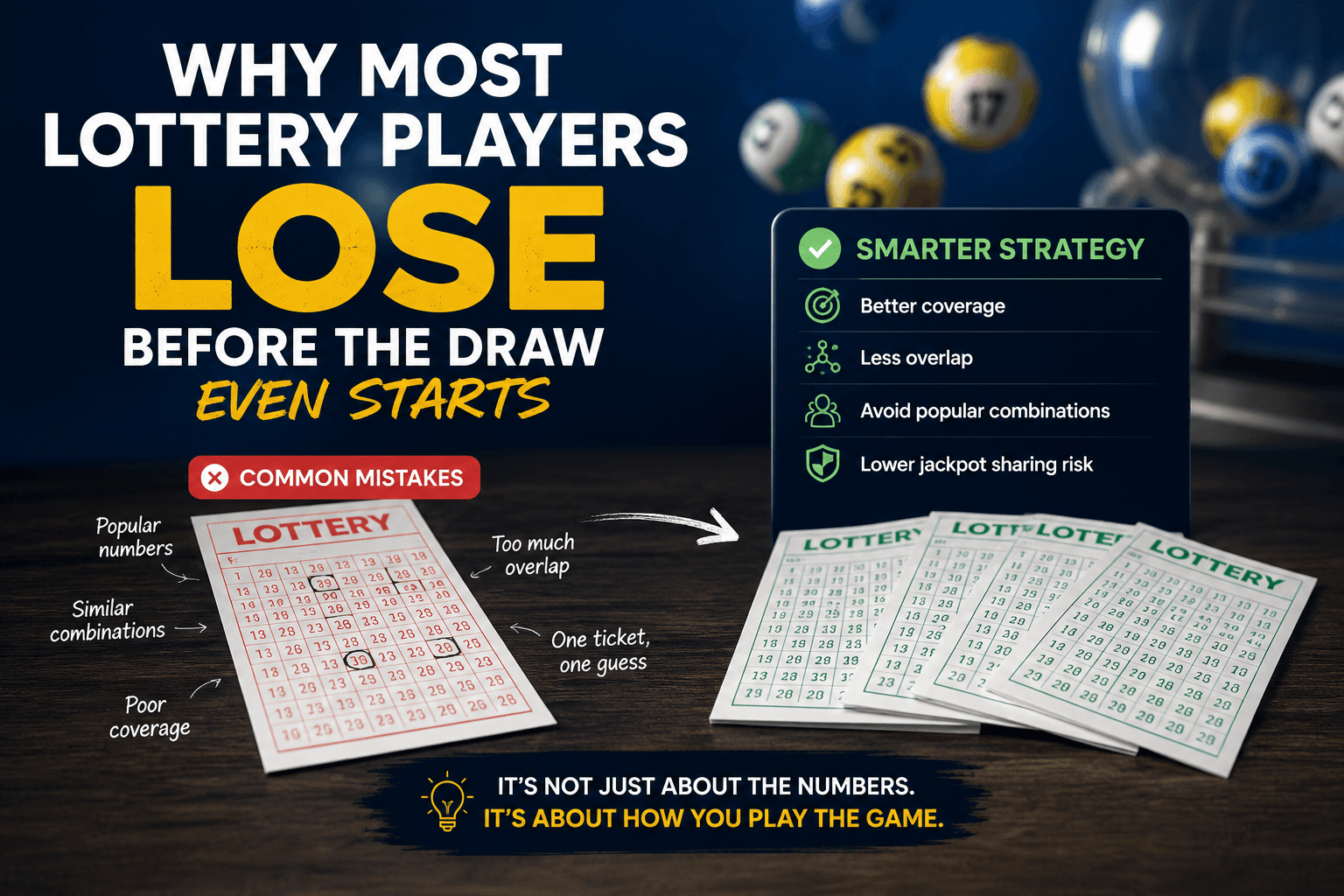
The uncomfortable truth is that millions of players make the same mistakes every week without realizing it:
- Picking popular numbers
- Repeating similar combinations
- Concentrating too many selections in the same number ranges
- Playing isolated tickets instead of coordinated ticket sets
The result?
Many players fail to cover the available number space long before the lottery balls are drawn.
The Lottery Myth: Finding the "Winning Numbers"
Search online, and you'll find endless advice on:
- Best lottery numbers
- Hot lottery numbers
- Cold lottery numbers
- Lucky lottery numbers
- Most overdue lottery numbers
The problem is that these approaches all focus on one main question:
"Which numbers should I pick?"
A better question is:
"How should I structure my tickets?"
Even if no one can predict winning numbers consistently, some ticket structures are clearly better than others.
Why Most Lottery Tickets Look Surprisingly Similar
Let's imagine 1,000 players buying tickets.
You might expect 1,000 completely different combinations.
That rarely happens.
Many players naturally gravitate toward:
- Birthdays
- Anniversaries
- Sequential numbers
- Patterns on the ticket slip
- Numbers they consider lucky
As a result, thousands of tickets often overlap around similar number combinations.
This creates two separate problems:
- Poor coverage of the available number space.
- A higher risk of sharing jackpots with other winners.
The irony is that even when players choose different numbers, their tickets often end up structurally similar.
Coverage Matters More Than Most People Think
Imagine you have eight tickets.
You could either:
- Generate eight independent random tickets.
- Build eight coordinated tickets designed to complement each other.
Both approaches use the same number of tickets.
But the second approach typically covers more of the available number space because each ticket is designed to fill gaps left by the others.
This concept is known as coverage optimization.
Instead of treating each ticket as an isolated guess, the entire ticket set is treated as a coordinated system.
That is one of the core principles behind modern lottery optimization.
The Hidden Cost of Popular Numbers
Most lottery players worry about winning.
Very few think about what happens after winning.
Consider two scenarios:
- You win alone.
- You win together with hundreds of other players holding similar combinations.
The prize can be dramatically different.
Popular combinations often include:
- Birthday-heavy numbers
- Symmetrical patterns
- Consecutive sequences
- Visually attractive ticket layouts
When many people choose the same combinations, jackpot sharing becomes more likely.
This is why some advanced lottery systems include crowd-avoidance models alongside traditional statistical models.
The goal isn't simply finding numbers.
The goal is finding opportunities that fewer people are pursuing.
Why AI Focuses on Ticket Sets Instead of Single Tickets
Many lottery systems still think in terms of single tickets.
Modern optimization engines think in terms of ticket sets.
A single ticket is one guess.
A coordinated set is a strategy.
Instead of asking:
"What are the best numbers?"
The better question becomes:
"What is the best combination of tickets?"
AI can evaluate thousands of possible ticket sets and compare them based on:
- Coverage
- Diversity
- Overlap reduction
- Statistical signal strength
- Crowd-avoidance characteristics
The result is a ticket set designed to work together rather than compete with itself.
The Real Goal
Let's be clear:
No system can guarantee lottery wins.
Lottery draws remain random events.
However, not all ticket sets are equal.
Some sets provide better coverage.
Some avoid unnecessary overlap.
Some reduce jackpot-sharing risk.
And some are simply more efficient than others.
That doesn't change the odds of the draw itself.
But it can improve the quality of the decisions made before the draw happens.
Final Thoughts
Most lottery players spend their time searching for the perfect number.
The smarter approach is often improving the structure behind the numbers.
Because long before the balls are drawn, many players have already reduced their chances through poor coverage, duplicated combinations, and predictable selections.
The biggest lottery mistake doesn't happen during the draw.
It happens before the draw even starts.
Try It Yourself
Discover data-driven predictions and strategies
Explore more from EuroLotto Prediction