
Search for lottery strategies online and you'll quickly find one idea repeated everywhere:
Play overdue numbers.
The theory sounds convincing.
If a number hasn't appeared for a long time, surely it must be more likely to appear soon.
After all, it feels impossible for a number to stay absent forever.
But is that actually how lottery probabilities work?
Let's look at what overdue numbers really are — and what they are not.
What Are Overdue Lottery Numbers?
An overdue lottery number is simply a number that hasn't appeared in recent draws.
For example:
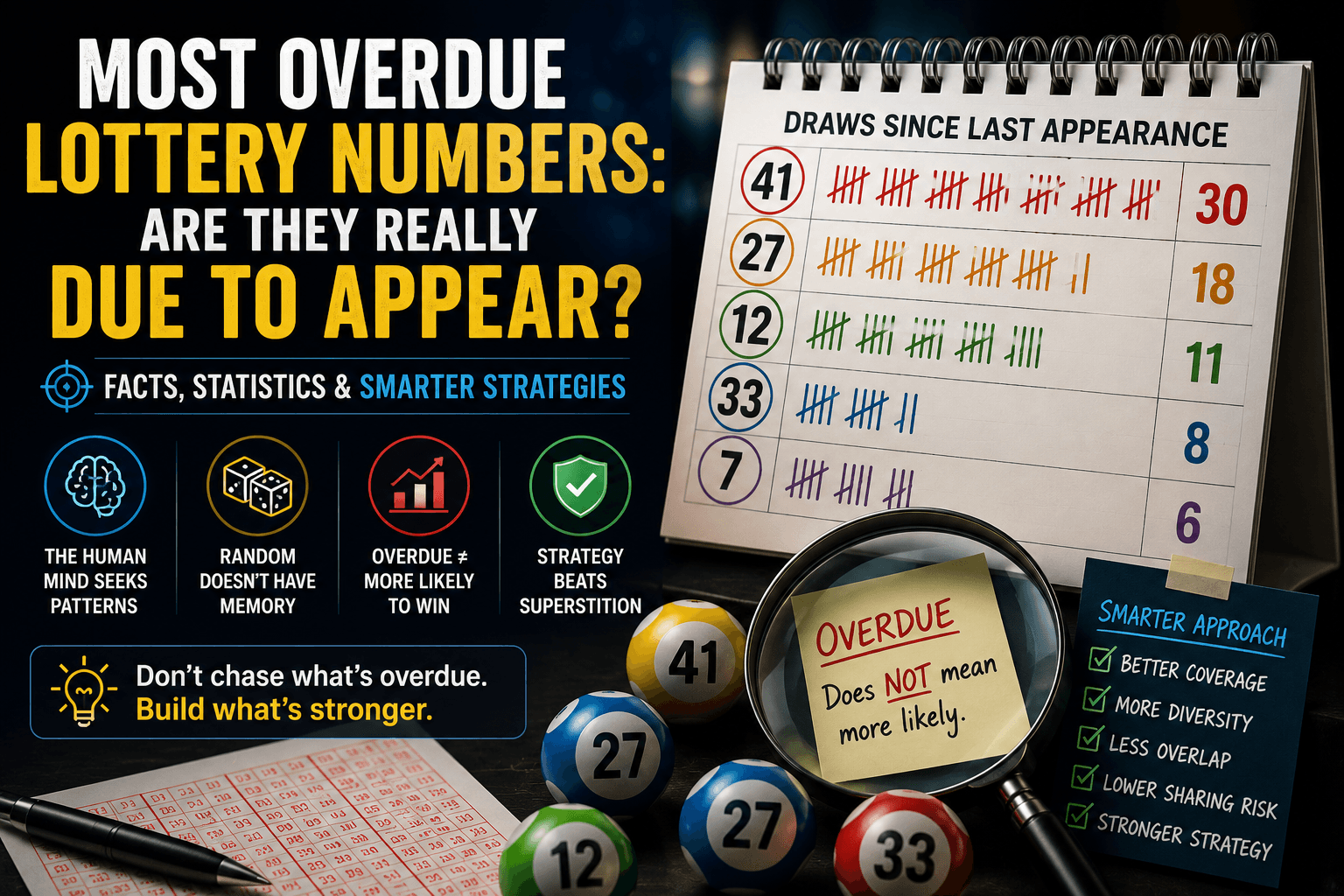
- Number 12 appeared three draws ago.
- Number 27 appeared ten draws ago.
- Number 41 hasn't appeared for thirty draws.
Most lottery tracking websites would classify 41 as highly overdue.
Many players interpret this as a signal.
The longer a number remains absent, the more attention it receives.
But attention and probability are not the same thing.
Why Overdue Numbers Feel Important
Humans naturally expect balance.
If red appears five times in a row on a roulette wheel, most people start expecting black.
If a lottery number disappears for months, many players expect it to return.
This feels logical.
The problem is that random systems don't have memory.
Lottery machines do not track which numbers appeared last week.
Each draw starts from scratch.
That means an overdue number is not automatically rewarded for being absent.
The Gambler's Fallacy Explained
This belief is so common that statisticians gave it a name:
The Gambler's Fallacy.
It occurs whenever someone believes past outcomes change the probability of future independent outcomes.
For example:
"Number 41 hasn't appeared in 30 draws. It has to come soon."
The assumption sounds reasonable.
The mathematics says otherwise.
If the draw is genuinely random, the probability of the next draw remains unchanged regardless of what happened previously.
Being overdue does not create a debt that probability must repay.
A Thought Experiment
Imagine flipping a fair coin.
You flip heads ten times in a row.
What is the probability of heads on the next flip?
Many people instinctively answer:
Less than 50%.
The correct answer is still:
50%.
The coin does not know what happened previously.
Lottery numbers behave in the same way.
Long streaks and long absences are normal features of randomness.
Why Some Numbers Stay Missing For So Long
One of the surprising realities of random systems is that extreme events happen more often than intuition suggests.
In a large enough sample, you should expect:
- Long streaks
- Long gaps
- Clusters
- Repeating patterns
These events feel unusual precisely because humans are poor at intuitively understanding randomness.
When a number remains absent for dozens of draws, it may feel impossible.
Statistically, it's completely normal.
Does That Mean Overdue Numbers Are Useless?
Not necessarily.
The mistake is treating overdue status as a prediction by itself.
Modern lottery analysis often considers recency as one signal among many.
For example:
- Frequency
- Recency
- Number-pair relationships
- Distribution balance
- Sequential draw patterns
- Crowd behavior
The difference is that overdue status is never treated as a standalone answer.
Instead, it becomes one small input in a much larger system.
The Problem With Building Tickets Around Overdue Numbers
Many players make the same mistake.
They select a list of overdue numbers and build every ticket around them.
This creates a hidden problem.
The tickets often become highly concentrated around a small group of numbers.
As a result:
- Coverage decreases
- Diversity decreases
- Ticket overlap increases
Ironically, players trying to improve their odds may actually reduce the effectiveness of their ticket set.
A good lottery strategy is usually about balancing many signals rather than chasing a single idea.
What Smarter Players Focus On
The strongest lottery strategies rarely begin with:
"Which numbers are overdue?"
Instead they ask:
"How can I build the strongest ticket set possible?"
That leads to different priorities:
- Better coverage
- Better diversification
- Less overlap between tickets
- Lower jackpot-sharing risk
- Stronger statistical balance
These factors can be measured and optimized.
Whether a single number is overdue becomes much less important.
Why Modern AI Models Treat Overdue Numbers Differently
Advanced lottery engines still monitor overdue behavior.
The difference is how the information is used.
Instead of making decisions based entirely on overdue numbers, the engine evaluates multiple competing signals simultaneously.
Sometimes overdue behavior supports a selection.
Sometimes other signals outweigh it.
The final decision comes from the combination of models rather than any single theory.
This helps avoid the biggest weakness of traditional lottery systems: becoming overly dependent on one idea.
Final Thoughts
Overdue lottery numbers are real.
Some numbers do stay absent longer than others.
What is not real is the belief that an overdue number is automatically more likely to appear next.
That's a common misunderstanding of probability.
The smarter approach is not chasing overdue numbers.
It's building stronger ticket sets with better coverage, diversification, and structure.
Because in lottery strategy, focusing on one number is rarely the advantage.
The advantage usually comes from how all your numbers work together.
Ready to try?
Discover data-driven predictions and strategies
Explore more from EuroLotto Prediction