
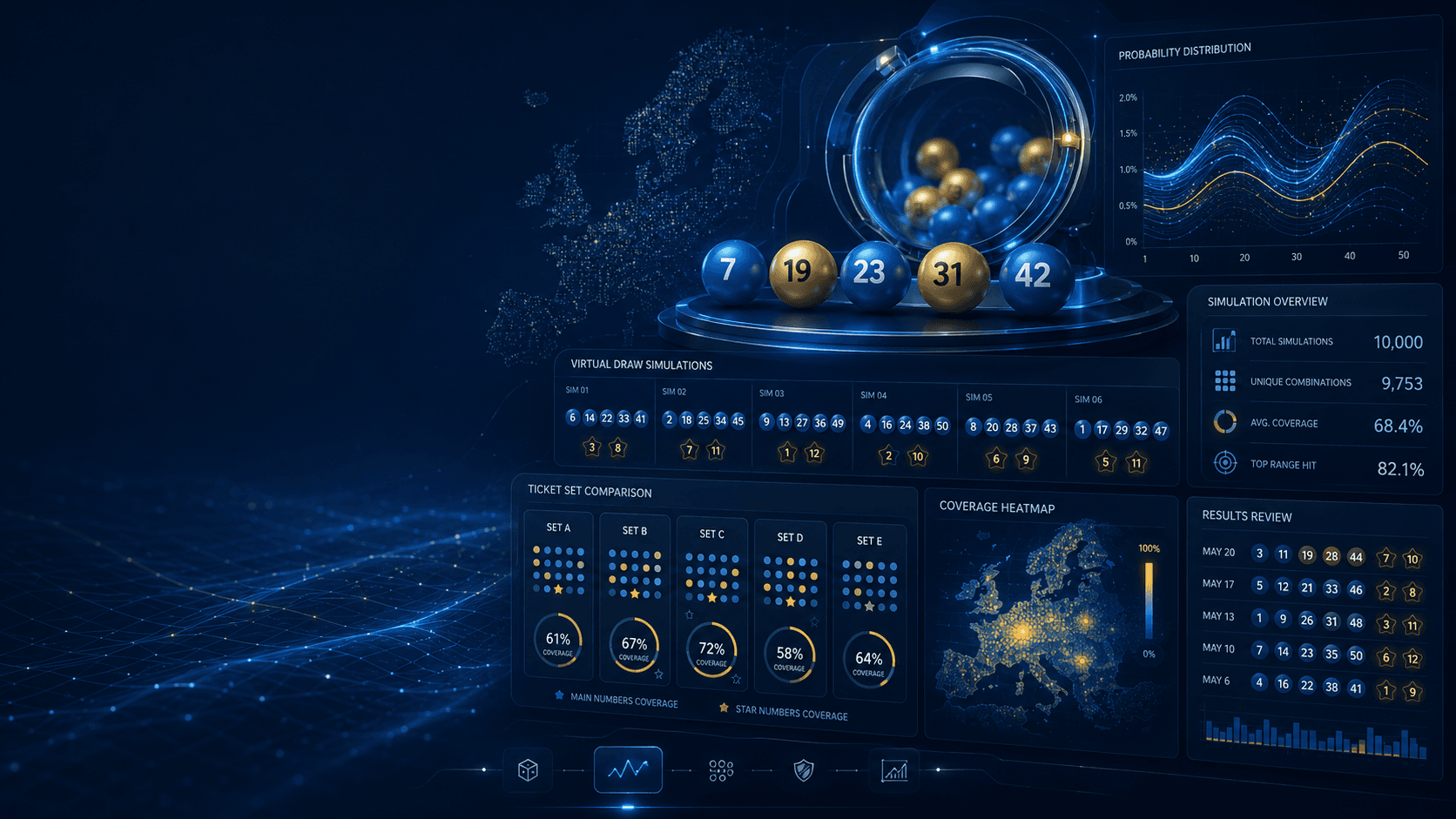
A lottery simulator sounds powerful.
It suggests you can test numbers.
Run virtual draws.
Compare ticket sets.
And maybe learn something before you play.
That can be useful.
But it is also easy to misunderstand.
A lottery simulator cannot predict winning numbers.
It cannot tell you what will happen in the next real draw.
It cannot guarantee a prize.
And it cannot make a random lottery result certain.
But a simulator can still help with something important:
“Understanding probability, rarity, and ticket structure.”
That is the right way to use it.
A lottery simulator is not a crystal ball.
It is a learning tool.
And when combined with a Virtual Vault, it can become part of a more structured way to save, test, and review lottery ticket sets.
The Quick Answer
A lottery simulator is a tool that runs virtual lottery-style draws or tests number sets against possible outcomes.
It can help you understand:
- how rare jackpot wins are
- how often smaller matches may appear
- how different ticket sets behave
- how multiple tickets compare
- whether a set has too much overlap
- whether numbers are spread well
- why lottery results are hard to predict
But it cannot tell you the next winning numbers.
The safe way to think about it is:
“A simulator helps you understand lottery structure. It does not predict the future.”
Useful page:
What Is a Lottery Simulator?
A lottery simulator is usually a digital tool that recreates lottery-style draws.
It may let you enter numbers.
It may generate random results.
It may run many simulated draws.
It may compare tickets against those simulated results.
The goal is to show how lottery probability behaves over time.
For example, a simulator can show that jackpot wins are extremely rare.
It can show that small matches happen more often.
It can show that buying more tickets increases coverage, but does not make winning easy.
That can be useful because lottery odds are hard to feel intuitively.
A simulator makes the scale more visible.
Why People Use Lottery Simulators
People use lottery simulators for several reasons.
Some want to test lucky numbers.
Some want to compare random tickets.
Some want to see how often a ticket might match something.
Some want to understand jackpot probability.
Some want to learn whether more tickets make a meaningful difference.
Some want to test AI-generated ticket sets.
Those are valid reasons.
But the expectation matters.
A simulator can help you understand the game.
It cannot tell you what the next real draw will do.
Simulation vs Prediction
Simulation and prediction are not the same.
Simulation asks:
“What could happen across many possible draws?”
Prediction asks:
“What will happen in the next draw?”
That difference is important.
A simulator may run thousands of virtual outcomes.
But those outcomes are not the official draw.
They are examples.
They help you understand probability.
They do not reveal the future.
So when using a lottery simulator, the safest mindset is:
“I am learning about the game, not discovering guaranteed numbers.”
What a Lottery Simulator Can Tell You
A lottery simulator can tell you useful things.
It can show how rare big wins are.
It can show how often small matches might appear in repeated trials.
It can show how different ticket sets compare in a simulated environment.
It can show whether multiple tickets create broader coverage.
It can show how random results can create surprising clusters.
It can show why short-term results are unstable.
It can show that losing many times in a row is normal in lottery games.
That kind of learning is valuable.
It helps keep expectations realistic.
What a Lottery Simulator Cannot Tell You
A lottery simulator cannot know the next winning numbers.
It cannot guarantee that a number will appear.
It cannot prove that hot numbers will stay hot.
It cannot prove that overdue numbers will return.
It cannot make one ticket line certain.
It cannot remove randomness.
It cannot replace official results.
A simulator can create examples.
But the real draw is still random.
That is the boundary.
Why Simulators Can Be Misleading
A simulator can become misleading if users treat simulated outcomes as signals.
For example, imagine a number appears often in a simulated run.
That does not mean it is more likely to appear in the real next draw.
Or imagine a ticket performs well in a short simulation.
That does not mean it is a stronger prediction.
Short simulation runs can create strange results.
Randomness can produce streaks, gaps, clusters, and patterns.
That does not mean those patterns are meaningful.
It means randomness is doing what randomness does.
Why Probability Feels Strange
Lottery probability is hard to understand because the numbers are so large.
A jackpot may have millions of possible combinations.
One ticket is only one combination.
Even several tickets cover only a tiny part of the full possibility space.
A simulator can help make this easier to see.
If you run many virtual draws and rarely see a jackpot match, that is not a failure.
It is the point.
The simulator is showing how rare jackpot wins really are.
That can help players stay realistic.
Simulating One Ticket
If you simulate one ticket, you are testing one combination.
That can show how that line behaves across virtual draws.
But one ticket gives limited insight.
It may occasionally match small prizes.
It may usually match little or nothing.
It may go through long dry periods.
That is normal.
One ticket is just one guess.
A simulator can help you feel that reality more clearly.
But it cannot make that one ticket more likely to win.
Simulating Multiple Tickets
Multiple tickets are more interesting to simulate.
That is because a ticket set can have structure.
If you test several tickets together, you can ask:
- do they overlap too much?
- do they cover different number ranges?
- do they repeat the same Lucky Stars?
- do they create broader coverage?
- do they behave differently across simulated draws?
This is where simulation becomes more useful.
Not because it predicts the result.
But because it helps compare ticket sets.
Lottery Simulator vs Virtual Vault
A lottery simulator and a Virtual Vault are related, but they are not the same.
A simulator usually creates virtual outcomes.
A Virtual Vault saves your real ticket set before the draw and reviews it after the official result.
That means:
- a simulator helps you understand possible outcomes
- the Virtual Vault helps you review what happened to your saved set
- a simulator is hypothetical
- the Vault is linked to your actual saved ticket set
- a simulator teaches probability
- the Vault supports post-draw review
Both can be useful.
But the Virtual Vault is more connected to your real playing routine.
Useful page:
Lottery Simulator vs Ticket Checker
A lottery ticket checker is used after a real draw.
It compares your numbers with the official result.
A simulator is different.
It does not need the official result.
It creates virtual scenarios instead.
So the difference is:
- a checker compares against a real result
- a simulator tests hypothetical outcomes
- a checker tells you what matched
- a simulator helps you understand probability
- a checker is practical after the draw
- a simulator is educational before or between draws
Useful page:
Where AI Picks Fit In
AI Picks can be combined with simulation-style thinking.
But not as prediction.
AI can help create ticket sets that are more structured.
Then a simulator or Vault-style review can help examine those sets.
AI can help with:
- number spread
- high and low balance
- odd and even balance
- repeated numbers
- ticket overlap
- Lucky Star distribution
- common player patterns
- birthday-number bias
This is useful because most players do not manually check the full structure of their tickets.
AI can do that faster.
But it still cannot predict the official draw.
Useful page:
AI Prediction vs AI Structure
The phrase “AI lottery prediction” is popular.
But it is not the best framing.
Prediction suggests that AI knows what will happen next.
That is not realistic.
A better framing is:
“AI helps structure and diversify lottery ticket sets.”
That is much safer.
AI can help build better sets.
It can reduce unnecessary overlap.
It can avoid too much birthday bias.
It can balance number ranges.
It can compare possible ticket groups.
But it cannot know the winning numbers.
That is why the Virtual Vault focuses on saving and reviewing sets.
Not promising predictions.
What Makes a Good Lottery Simulator?
A good lottery simulator should be honest.
It should explain what it can and cannot do.
It should show probability clearly.
It should avoid prediction claims.
It should help users understand that wins are rare.
It should let users compare different ticket sets.
It should show small matches as well as jackpot outcomes.
It should remind users that simulated results are not official results.
Most importantly, it should not create false confidence.
A simulator should educate.
Not mislead.
What Makes a Bad Lottery Simulator?
A bad lottery simulator makes unrealistic promises.
It may suggest that simulated success means future success.
It may claim to find winning patterns.
It may encourage users to chase losses.
It may overstate hot numbers or overdue numbers.
It may make random results look more meaningful than they are.
That is risky.
A responsible simulator should not sell certainty.
It should explain uncertainty.
Testing Numbers With a Simulator
If you use a simulator to test lottery numbers, use it carefully.
Do not ask:
“Will these numbers win?”
Ask:
“How does this set behave in repeated scenarios?”
That is a better question.
You can look at:
- how often small matches appear
- how the set covers number ranges
- whether ticket overlap is too high
- whether some numbers repeat too often
- whether Lucky Stars are diversified
- whether the set is too narrow
This is structure testing.
Not prediction.
Testing Numbers With the Virtual Vault
The Virtual Vault adds another layer.
Instead of only using hypothetical simulation, you can save your ticket set before the real draw.
Then, after the official result, you can review what happened.
That makes the process more practical.
The Vault can help you ask:
- which line performed best?
- did any line come close?
- did the set have useful coverage?
- did too many tickets repeat the same numbers?
- should the set be refreshed?
- did the structure make sense?
This creates a better loop than simply generating new numbers every time.
Why Post-Draw Review Matters
Post-draw review helps players learn from what happened.
Not to predict the future.
But to understand structure.
After the draw, you can see whether your saved set had:
- matched numbers
- matched Lucky Stars
- near-misses
- broad coverage
- repeated overlap
- weak number spread
- strong or weak set structure
This can make the lottery experience more thoughtful.
It also helps avoid emotional guessing.
You are reviewing a saved set.
Not just reacting to a loss.
Example: Simulator Only
Imagine you enter one ticket into a simulator.
The simulator runs many virtual draws.
Most of the time, the ticket does not win a major prize.
Sometimes it may match a few numbers.
Very rarely, it may show a bigger simulated match.
That can be interesting.
But the result is still simulated.
It does not mean the ticket is better for the next official draw.
It only shows how probability might behave in a virtual environment.
Example: Virtual Vault Review
Now imagine you generate six AI ticket lines.
You save them in the Virtual Vault before the draw.
After the official draw, you review the set.
You see which line matched best.
You see whether the Lucky Stars were close.
You see whether coverage was broad.
You see whether several tickets were too similar.
That review is tied to a real result.
It still does not predict the future.
But it gives you a more useful record.
Why Short Simulations Can Be Unstable
Short simulations can produce strange results.
A number may appear many times.
Another number may disappear.
One ticket may look unusually strong.
Another may look unusually weak.
That does not necessarily mean anything.
Small samples can be noisy.
This is one reason players should be careful when interpreting simulation output.
A simulator is useful when it teaches probability.
It becomes risky when users treat every short-term pattern as a signal.
Why Long Simulations Are Better for Learning
Longer simulations can show probability more clearly.
They can help users understand that unusual events happen over time.
They can show that random results do not distribute perfectly in the short term.
They can show how rare jackpot-level matches are.
But even long simulations do not predict the next real draw.
They are still educational.
Not prophetic.
Can a Simulator Improve Your Ticket Set?
A simulator can help you compare ticket sets.
That can be useful.
But the improvement is about structure.
Not guaranteed outcomes.
For example, a simulator may help you notice that one set has too much overlap.
Or that another set spreads numbers more broadly.
Or that Lucky Stars are repeated too heavily.
That information can help you build better sets.
But it still cannot guarantee a prize.
Can the Virtual Vault Improve Your Ticket Routine?
Yes.
The Virtual Vault can improve your process.
It helps you:
- save ticket sets
- avoid forgetting what you played
- review after the draw
- compare sets over time
- understand coverage
- refresh more deliberately
- stay focused on structure instead of prediction
That is the real value.
It turns number picking into a more organized routine.
Not a guaranteed winning system.
Responsible Use of Simulators
A lottery simulator should be used responsibly.
It should not encourage overplaying.
It should not make losses feel like future wins are owed.
It should not suggest that enough simulation can reveal certainty.
The right approach is:
- set a fixed budget
- treat lottery as entertainment
- use tools for clarity
- avoid prediction claims
- review structure calmly
- never chase losses
This applies to simulators, AI Picks, checkers, and the Virtual Vault.
Common Mistakes With Lottery Simulators
Players often make the same mistakes.
They treat simulated results as predictions.
They trust short-term patterns too much.
They assume a ticket that performed well in simulation is likely to win.
They ignore randomness.
They use simulation to justify spending more.
They forget that official draws are independent.
They confuse virtual outcomes with real results.
A better mindset is:
“Simulation helps me understand probability, not beat randomness.”
A Simple Safe Workflow
A safe workflow could look like this.
First, generate or choose a ticket set.
Then check its structure.
Next, save it in the Virtual Vault.
After the official draw, review the result.
Then refresh or adjust the next set if needed.
This workflow keeps the focus on structure.
It also avoids the false promise of prediction.
Useful page:
Final Thoughts
A lottery simulator can be useful.
It can help you understand probability.
It can show how rare big wins are.
It can help compare ticket sets.
It can support better number strategy.
But it cannot predict winning numbers.
That is the most important point.
The Virtual Vault takes the idea further by helping you save real ticket sets before the draw and review them after the official result.
Together, simulation thinking and Vault review can make lottery play more structured.
But not certain.
The safest message is simple:
“Use simulation to understand probability. Use the Virtual Vault to review structure. Do not treat either one as prediction.”
That is the smarter way to use lottery tools.
FAQ
What is a lottery simulator?
A lottery simulator is a tool that runs virtual lottery-style outcomes or tests number sets against simulated draws.
Can a lottery simulator predict winning numbers?
No. A lottery simulator cannot predict winning numbers. It can only show hypothetical outcomes and probability examples.
What can a lottery simulator tell me?
It can help you understand probability, how rare wins are, how ticket sets behave, and why structure matters.
Is a lottery simulator the same as a ticket checker?
No. A checker compares your numbers with an official result after the draw. A simulator creates hypothetical outcomes.
Is a lottery simulator the same as the Virtual Vault?
No. A simulator is hypothetical. The Virtual Vault saves your ticket set before the draw and reviews it after the real result.
Can AI improve lottery simulation?
AI can help structure and compare ticket sets, but it cannot predict the official winning numbers.
Should I use simulation before choosing numbers?
You can use simulation to understand probability and compare structures, but not to choose guaranteed winning numbers.
Does a good simulation result mean my ticket will win?
No. A good simulated result does not guarantee success in a real draw.
Where can I save and review ticket sets?
You can use the Virtual Vault to save and review structured ticket sets.
Try the Virtual Vault
Discover data-driven predictions and strategies
Explore more from EuroLotto Prediction