
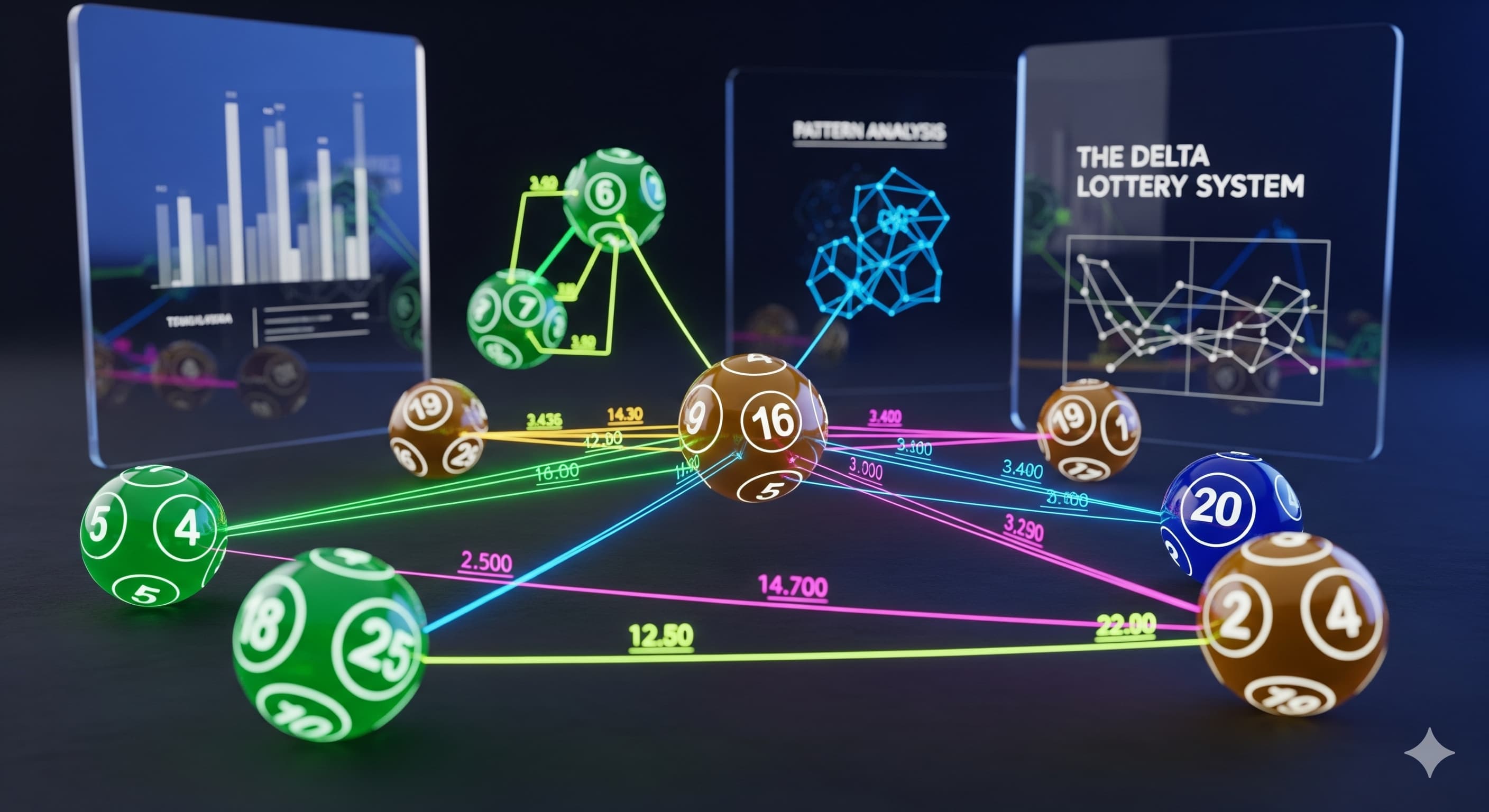
Most players look at lottery numbers as individual digits—like picking birthdays or lucky charms. Another way to look at a combination is the space between the numbers.
This is called Delta Analysis (or the Delta System). It describes the shape of a combination; it does not make any combination more likely to win.
In this guide, we’ll explain how the Delta System works and how the Delta Patterns strategy in EuroLotto Predictor uses a related idea.
What is a "Delta"?
In mathematics, a "Delta" ($\Delta$) represents the difference or change between two values. In the lottery, it is the number of steps you have to count to get from one winning ball to the next.
Example Calculation:
Imagine the winning numbers are: 3, 9, 15, 20, 45.
Here are the Deltas for this ticket:
- 3 (Distance from 0 to 3)
- 6 (9 minus 3)
- 6 (15 minus 9)
- 5 (20 minus 15)
- 25 (45 minus 20)
The "Texture" of Randomness
Why look at this? Because it shows what random draws tend to look like as a group — not which combination comes next.
If you pick numbers like 5, 10, 15, 20, 25, the Deltas are all exactly 5. Evenly spaced combinations are rare as a group, simply because there are few of them — but this exact combination is as likely to be drawn as any other.
Real lottery draws are "messy", just as random combinations would be. In our dataset (478 Eurojackpot draws, January 2022 to 11 September 2026), 69.5% of draws include at least one Delta of 1 or 2 — almost the same as the 68.9% of all possible combinations. The textbook profile below (at least one small, two medium and one large Delta) appears in only 8.2% of draws (8.0% of all combinations):
- One very small Delta (e.g., 1 or 2).
- Two medium Deltas (e.g., 6 to 10).
- One large jump (e.g., 20+).
A simple check: because the first Delta is counted from 0, your Deltas always add up to the highest number in your combination (at most 50 in Eurojackpot). That is arithmetic, not a rule that makes a combination better.
What the Delta System Can Do for You
Deltas help you notice combinations built from very regular patterns. Those combinations are not less likely to be drawn than any other — the Delta System only makes the shape of your selection visible.
- Clumped:
1, 2, 3, 4, 5has the Deltas 1, 1, 1, 1, 1. It is exactly as likely to be drawn as any other combination; the Deltas only make the clumping visible. - Spread out:
1, 15, 30, 45, 50has the Deltas 1, 14, 15, 15, 5 — spread across the whole range, and again no more or less likely than any other combination.
Our Delta Patterns strategy does not use a learned "Delta Signature". It looks at the last 50 draws and scores each number by how often it appeared in each sorted position (lowest to highest). That describes the typical spread of past draws; it cannot tell which combination comes next.
How to Use It in EuroLotto Predictor
You don't need to do the math yourself. The Delta Patterns strategy is one of the signals our engine can weight when it generates tickets.
- Go to Advanced Statistics (The Lab).
- Find the "Delta Patterns" slider.
- Set it to 20% - 30%.
When you generate a ticket, the engine gives more weight to numbers that often appeared in similar positions in the last 50 draws. It does not reject any combination, and it changes which numbers you play — not the odds of any combination.
Ready to build your set?
Generate Your Ticket Set
Try the Delta Patterns strategy
Discover data-driven predictions and strategies
Explore more from EuroLotto Prediction