
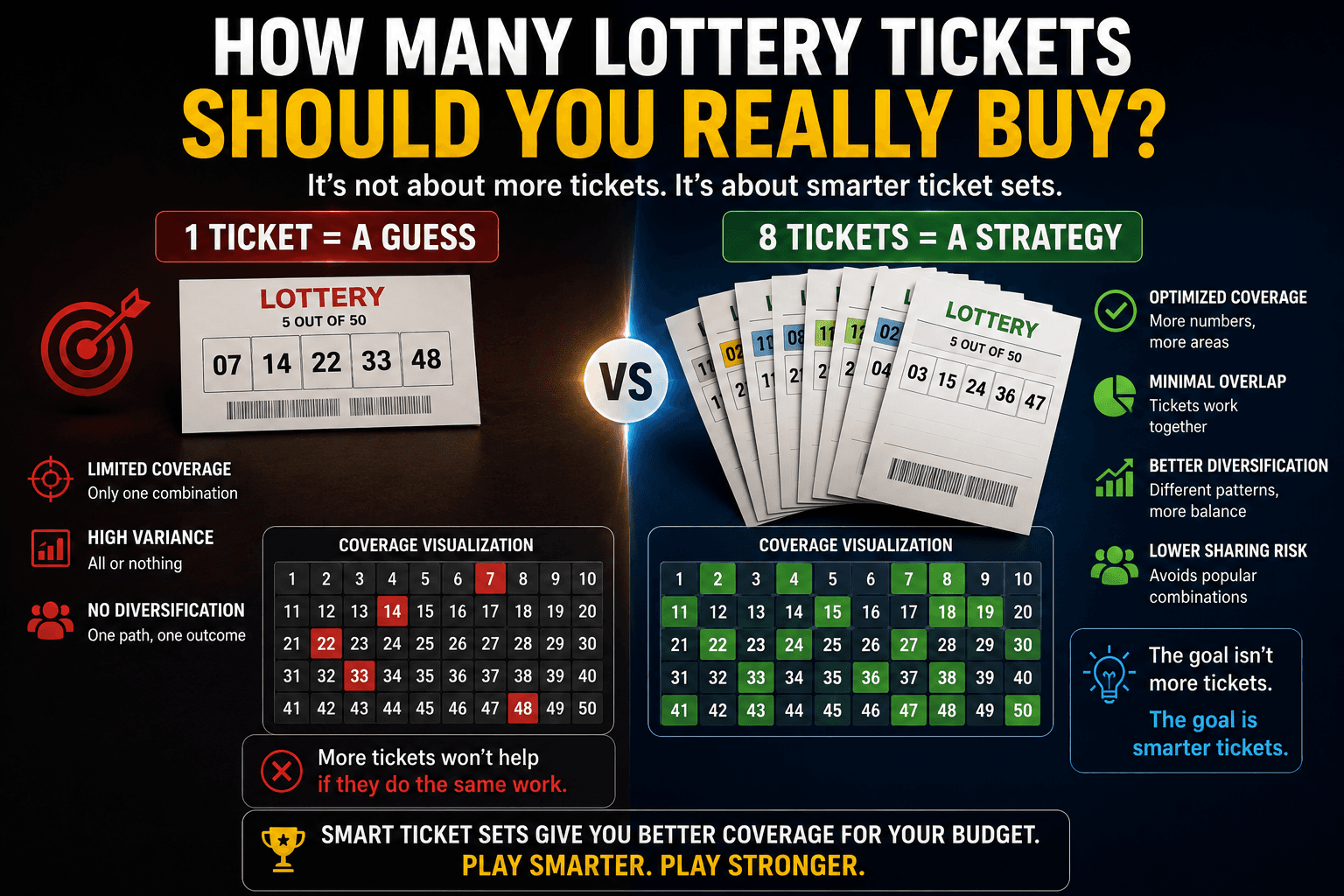
Most lottery players ask the same question before every draw:
“Which numbers should I pick?”
It feels like the obvious place to start.
Hot numbers, cold numbers, birthdays, lucky numbers, random picks — everyone has a method.
But there is another question that often matters more:
“How many tickets should I buy?”
And even more importantly:
“Do my tickets actually work together?”
Because buying more tickets is not automatically the same as playing smarter.
One Ticket Is Just One Guess
A single lottery ticket is one possible combination.
That’s all.
It might be based on birthdays. It might be randomly generated. It might come from a favorite set of numbers.
But in the end, it is still one guess.
There is nothing wrong with that. Many people play casually, and one ticket is enough if the goal is simply to enjoy the draw.
But if you are buying several tickets, the situation changes.
At that point, it makes sense to stop thinking only about individual tickets and start thinking about the full ticket set.
The Real Problem With Buying More Tickets
Many players assume that more tickets automatically mean better coverage.
That is partly true.
More tickets do give you more combinations.
But they can also repeat the same ideas again and again.
For example, if several tickets include similar number ranges, similar patterns, or the same repeated numbers, they may not add as much new coverage as you expect.
You paid for more tickets.
But mathematically, some of those tickets may be doing very similar work.
That is the hidden problem.
Random Tickets Can Overlap More Than You Think
Imagine buying eight random tickets.
It feels like you should now have eight completely different chances.
But random selection often creates:
- repeated numbers
- similar number ranges
- uneven spread
- clusters
- gaps
This is normal.
Random does not mean perfectly spread out.
Random does not mean optimized.
It simply means no deliberate structure was used.
So the real question becomes:
“How much useful coverage did those tickets actually create?”
What Is Useful Coverage?
Useful coverage means that each ticket adds something new to the set.
A simple example:
If Ticket 1 already covers several low numbers, maybe Ticket 2 should help cover a different range.
If several tickets already contain the same repeated number, maybe the next ticket should bring in something different.
If all tickets look structurally similar, the set may be less diversified than it appears.
Good coverage is not about filling tickets randomly.
It is about making sure the tickets do not waste space by duplicating each other too much.
The Difference Between More Tickets and Better Tickets
Let’s say two players each buy eight tickets.
Player A uses eight random picks.
Player B uses eight tickets designed to work together.
Both spend the same amount of money.
But Player B may end up with:
- more unique numbers covered
- less overlap between tickets
- better high/low balance
- better odd/even balance
- fewer overly popular combinations
That does not guarantee a win.
But it does mean the ticket set is built more efficiently.
And that is the point.
Is There a Perfect Number of Tickets?
There is no perfect number.
If someone tells you there is one magic amount, be careful.
The right number depends on your budget, how often you play, and whether you are playing casually or more strategically.
But for many regular players, the practical range is usually somewhere between:
- 3 tickets
- 6 tickets
- 8 tickets
- 12 tickets
Why this range?
Because it is large enough to build a real ticket set, but still small enough to remain realistic for normal weekly play.
One ticket is simple.
Three tickets give a little more spread.
Six to eight tickets allow much better coverage.
Twelve tickets can create a stronger set, especially when the tickets are coordinated instead of random.
Why 6 to 12 Tickets Often Makes Sense
For many players, 6 to 12 tickets is a useful balance.
It gives enough room to diversify without turning the lottery into a huge expense.
With only one ticket, you have almost no flexibility.
With three tickets, you can start spreading numbers a little.
With six tickets, the set can begin to cover different structures.
With twelve tickets, you can usually create a much broader spread across the number pool.
But again, the important part is not only the number of tickets.
It is how those tickets are built.
The Set Matters More Than Any Single Ticket
This is the biggest mindset shift.
Once you buy more than one ticket, each ticket should not be judged alone.
The better question is:
“Does this ticket improve the whole set?”
A good ticket set should aim for:
- broader coverage
- less unnecessary overlap
- balanced structure
- better diversification
- lower exposure to common player patterns
That is why coordinated ticket sets are different from random picks.
They are designed as a group.
Why AI Is Useful Here
AI does not make the lottery predictable.
No honest system can do that.
But AI can evaluate many possible ticket sets very quickly.
It can compare different combinations and ask:
- Are these tickets too similar?
- Are too many numbers repeated?
- Is the number range too narrow?
- Is the structure balanced?
- Does this set cover more space than random picks?
- Are these combinations too popular with other players?
That is where AI can be useful.
Not by promising winning numbers.
But by helping build better ticket sets.
What About Budget?
This part matters.
The smartest ticket set is not the one that forces you to spend more than you planned.
A good lottery strategy should always start with a fixed budget.
Decide what you are comfortable spending first.
Then build the best possible set inside that budget.
For some players, that means one or two tickets.
For others, it may mean six, eight, or twelve.
The point is not to buy the maximum number possible.
The point is to make the tickets you buy work harder.
So, How Many Tickets Should You Buy?
A simple answer would be:
- 1 ticket if you play casually
- 3 tickets if you want a small spread
- 6 tickets if you want a real set
- 8 to 12 tickets if you want stronger coverage
But the better answer is this:
Buy only as many tickets as fit your budget — and make sure they work together.
Because ten poorly structured tickets can still waste coverage.
And six well-coordinated tickets may be much smarter than six random ones.
Final Thoughts
More tickets can help.
But only if they add useful coverage.
If they repeat the same numbers, follow the same patterns, or overlap too much, the benefit is smaller than most players expect.
That is why the real question is not only:
“How many lottery tickets should I buy?”
The better question is:
“How well does my ticket set work together?”
A single ticket is a guess.
A coordinated ticket set is a strategy.
Create you own Set
Discover data-driven predictions and strategies
Explore more from EuroLotto Prediction