
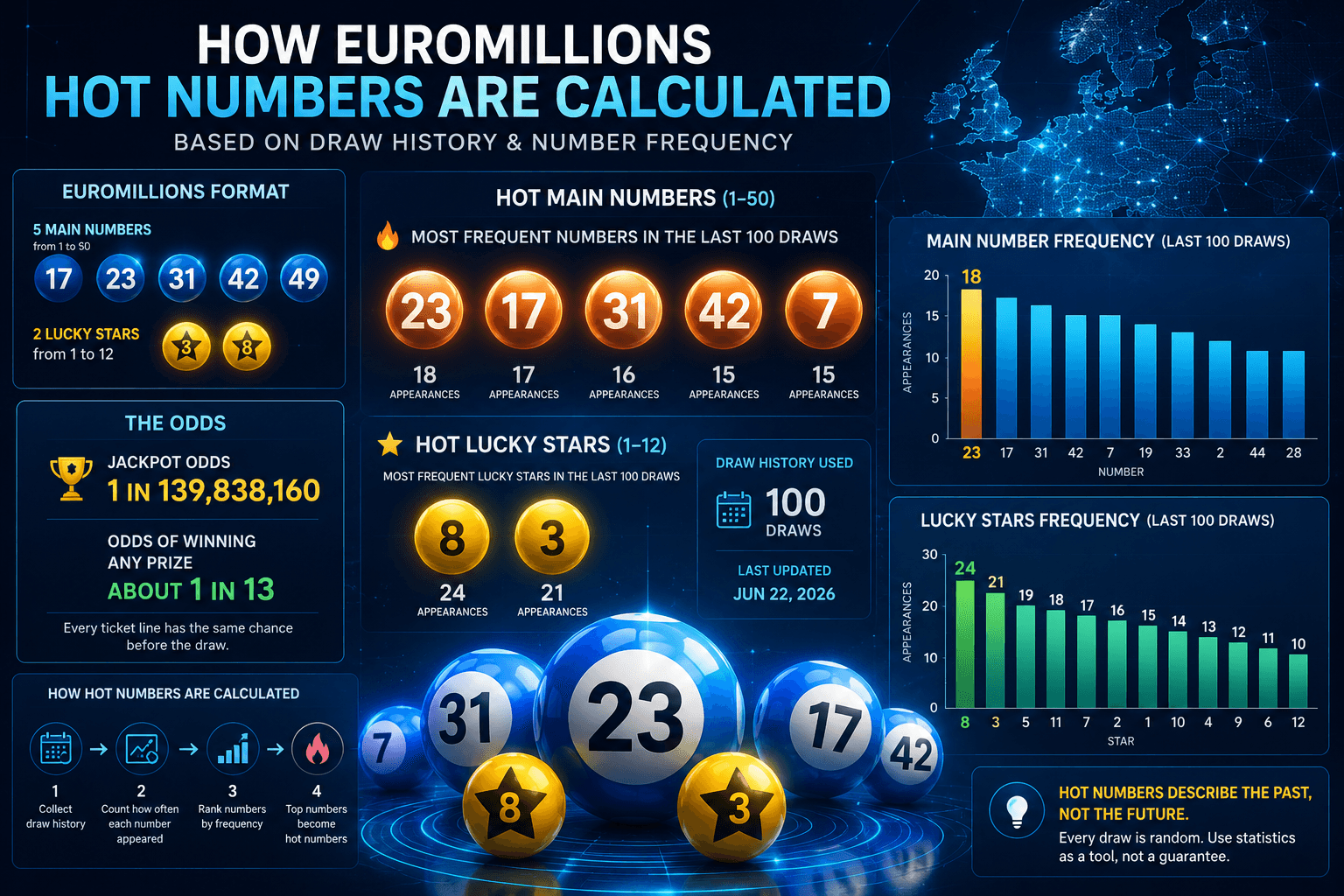
EuroMillions players love looking at numbers.
Some players check birthdays.
Some check lucky numbers.
Some use random picks.
And many players look at hot numbers before every draw.
The idea sounds simple:
“Which EuroMillions numbers appear most often?”
But hot numbers are often misunderstood.
A hot number is not a guaranteed prediction.
It is not a magic signal.
And it does not mean the number must appear again soon.
A hot number simply means that a number has appeared more often than others in a selected set of past draws.
That is all.
But when calculated properly, hot numbers can still be useful.
Not because they predict the future.
But because they help you understand draw history, number frequency, and ticket structure.
The Quick Answer
EuroMillions hot numbers are calculated by counting how many times each number appeared in previous draws.
For the main numbers, the system counts numbers from 1 to 50.
For the Lucky Stars, it counts Lucky Stars from 1 to 12.
The numbers with the highest appearance counts are usually called hot numbers.
For example:
- if number 23 appeared more often than most other main numbers, it may be marked as hot
- if Lucky Star 8 appeared more often than other Lucky Stars, it may be marked as a hot Lucky Star
- if a number appeared often in recent draws, it may be marked as recently hot
The important point is this:
“Hot numbers describe the past. They do not guarantee the future.”
How EuroMillions Numbers Work
EuroMillions uses two number pools.
Every line contains:
- 5 main numbers from 1 to 50
- 2 Lucky Stars from 1 to 12
That means hot numbers should also be calculated separately.
Main numbers and Lucky Stars are not the same pool.
A main number cannot be compared directly with a Lucky Star.
So a good EuroMillions statistics page should usually show:
- hot main numbers
- cold main numbers
- hot Lucky Stars
- cold Lucky Stars
- recent trends
- long-term frequency
- overdue numbers
- draw history
Useful pages:
What Is a Hot Number?
A hot number is a number that appeared more often than other numbers in a defined draw history.
That draw history can be:
- all available EuroMillions draws
- the last 100 draws
- the last 50 draws
- the last 20 draws
- a custom time period
This matters because the result can change depending on the time window.
A number may be hot across all historical draws.
But it may not be hot in the last 50 draws.
Another number may look very hot recently, but only average over the full draw history.
So whenever you see a hot number list, you should always ask:
“Hot over which period?”
Without the time period, the ranking is incomplete.
Basic Hot Number Calculation
The basic calculation is simple.
First, collect the draw history.
Then count how often each number appeared.
For EuroMillions main numbers, you count all main numbers from each draw.
For example, every draw has 5 main numbers.
If you analyze 100 draws, you are looking at:
- 100 draws
- 5 main numbers per draw
- 500 main number appearances in total
Then you count how many times each number from 1 to 50 appeared inside those 500 positions.
The numbers with the highest counts become the hot main numbers.
The same logic applies to Lucky Stars.
Every draw has 2 Lucky Stars.
If you analyze 100 draws, you are looking at:
- 100 draws
- 2 Lucky Stars per draw
- 200 Lucky Star appearances in total
Then you count how many times each Lucky Star from 1 to 12 appeared.
The Lucky Stars with the highest counts become the hot Lucky Stars.
Simple Example
Imagine a very small sample of 5 EuroMillions draws.
That would contain:
- 25 main number appearances
- 10 Lucky Star appearances
If number 17 appeared 3 times in those 5 draws, while most other numbers appeared once or not at all, number 17 would look hot in that small sample.
But that does not mean number 17 is more likely to appear in the next draw.
It only means it appeared more often in that short period.
This is why sample size matters.
Small samples can create very unstable hot number lists.
Large samples are more stable, but they can also hide recent changes.
Long-Term Hot Numbers vs Recent Hot Numbers
There are two common ways to calculate hot numbers.
The first is long-term frequency.
This looks at all available draw history.
It answers the question:
“Which numbers have appeared most often overall?”
The second is recent frequency.
This looks at a smaller recent window, such as the last 20, 50, or 100 draws.
It answers the question:
“Which numbers have appeared most often recently?”
Both views can be useful.
But they tell different stories.
Long-term hot numbers show historical frequency.
Recent hot numbers show current momentum in the draw history.
Neither view guarantees what happens next.
Why Time Window Matters
The time window can completely change the result.
For example, a number might be among the top 5 most frequent numbers across all historical draws.
But in the last 50 draws, it might barely appear.
Another number might be average over the full history, but very active recently.
That is why a good statistics page should not only show one list.
It should help players compare different views:
- all-time hot numbers
- recent hot numbers
- cold numbers
- overdue numbers
- number frequency
- Lucky Star frequency
- draw history
This gives a more complete picture.
Useful page:
Hot Main Numbers and Hot Lucky Stars
Main numbers and Lucky Stars should always be calculated separately.
The reason is simple.
Main numbers come from a pool of 50.
Lucky Stars come from a pool of 12.
That means the expected frequency is different.
A Lucky Star should appear more often than a main number because there are fewer Lucky Stars in the pool.
So if Lucky Star 3 appeared 20 times and main number 37 appeared 20 times, those two facts do not mean the same thing.
They come from different pools.
A clean EuroMillions hot number calculation separates them into two rankings:
- hot main numbers from 1 to 50
- hot Lucky Stars from 1 to 12
This avoids mixing different types of numbers.
What Is Expected Frequency?
Expected frequency is the average number of times a number would appear if draws were evenly distributed over time.
For main numbers, each draw selects 5 numbers from 50.
So in a very simple sense, each main number has a 5 out of 50 chance of appearing in a draw.
That is the same as 1 out of 10.
So over 100 draws, a main number might be expected to appear around 10 times on average.
For Lucky Stars, each draw selects 2 Lucky Stars from 12.
So each Lucky Star has a 2 out of 12 chance of appearing in a draw.
That is the same as 1 out of 6.
So over 100 draws, a Lucky Star might be expected to appear around 16 or 17 times on average.
Real draw history will not be perfectly even.
Some numbers will appear more often.
Some will appear less often.
That difference is what creates hot and cold number lists.
Hot Numbers vs Cold Numbers
Hot numbers and cold numbers are opposite views of the same data.
Hot numbers are the numbers that appeared more often.
Cold numbers are the numbers that appeared less often.
For example:
- a hot number may have appeared more than expected
- a cold number may have appeared less than expected
- an average number may sit close to expected frequency
Some players prefer hot numbers because they believe active numbers may continue.
Other players prefer cold numbers because they believe missing numbers may return.
Both ideas are popular.
But both should be treated carefully.
Lottery draws are random.
A hot number is not guaranteed to stay hot.
A cold number is not guaranteed to appear soon.
Hot Numbers vs Overdue Numbers
Hot numbers and overdue numbers are also different.
A hot number is based on total frequency.
An overdue number is based on time since last appearance.
A number can be hot and overdue at the same time.
For example, it may have appeared many times historically, but not in the most recent draws.
A number can also be cold but not overdue.
It may appear occasionally, but still have a low total count.
That is why hot number analysis and overdue number analysis should not be mixed together.
They measure different things.
Useful pages:
Are Hot Numbers Better Picks?
Not automatically.
This is the most important warning.
Hot numbers are based on past results.
But the next EuroMillions draw is still random.
Every valid combination has the same jackpot chance before the draw.
So a ticket with hot numbers is not mathematically guaranteed to be better than a ticket with cold numbers.
However, hot numbers can still be useful as part of a broader ticket-building process.
They can help you avoid choosing numbers blindly.
They can help you understand historical patterns.
They can help you build a more balanced ticket set.
But they should not be used as the only rule.
The Risk of Only Picking Hot Numbers
A common mistake is to fill a ticket only with hot numbers.
That can create problems.
If many players use the same public hot number list, they may choose similar combinations.
That does not reduce the chance of the combination being drawn.
But it could increase the chance of sharing a prize if that combination wins.
There is also a structural issue.
A ticket made only from hot numbers might become too narrow.
It might ignore number spread.
It might ignore odd and even balance.
It might ignore high and low balance.
It might repeat the same logic across several tickets.
So hot numbers should be an input, not the full strategy.
Better Ways to Use Hot Numbers
A more balanced approach is to use hot numbers together with other checks.
For example, you might look at:
- hot numbers
- cold numbers
- overdue numbers
- number spread
- odd and even balance
- high and low balance
- sum range
- repeated numbers across tickets
- Lucky Star distribution
- common player patterns
This creates a more complete ticket-building method.
Instead of asking:
“Which hot numbers should I pick?”
Ask:
“How do hot numbers fit into the full ticket set?”
That is a better question.
Hot Numbers and AI Picks
AI can be useful because it can process several number views at the same time.
A human player might look only at a hot number list.
AI can look at a broader set of rules.
It can compare:
- frequency
- recency
- overdue status
- number balance
- ticket overlap
- main number distribution
- Lucky Star distribution
- common patterns
- set diversification
This does not mean AI can predict the next draw.
It cannot.
But it can help build ticket sets that are more structured than simple manual picking.
Try:
Why Hot Numbers Change Over Time
Hot number lists are not fixed.
They change when new draws are added.
Every new EuroMillions result updates the frequency counts.
If a number appears again, its count increases.
If it does not appear, other numbers may catch up.
This is why hot number rankings can slowly shift over time.
Recent hot number lists can change quickly.
All-time hot number lists usually change more slowly because they are based on a larger history.
That is also why draw history matters.
Without fresh results, hot number lists become outdated.
Useful page:
What a Good Hot Number Page Should Show
A useful EuroMillions hot number page should not only show a list of numbers.
It should explain the calculation.
Ideally, it should show:
- the selected time window
- main number frequency
- Lucky Star frequency
- draw count used
- last updated date
- hot numbers
- cold numbers
- overdue numbers
- links to draw history
- a clear warning that past results do not guarantee future results
This makes the data easier to understand.
It also helps players avoid treating hot numbers as magic predictions.
Common Mistakes With Hot Numbers
Many players make the same mistakes when using hot numbers.
They assume hot numbers are more likely to appear again.
They are not guaranteed to.
They ignore the time window.
That can make the ranking misleading.
They mix main numbers and Lucky Stars.
Those should be separate.
They use only hot numbers.
That can create a narrow ticket set.
They forget about ticket overlap.
Several tickets can repeat too many of the same ideas.
They treat statistics as prediction.
Statistics are useful, but they are not certainty.
The better mindset is:
“Hot numbers are a historical signal, not a promise.”
How We Use Hot Numbers in Ticket Strategy
In a structured EuroMillions ticket strategy, hot numbers should be one layer.
They can help inform the ticket set, but they should not control everything.
A better approach is to combine them with:
- recent and long-term frequency
- cold number analysis
- overdue number checks
- balanced number ranges
- Lucky Star spread
- reduced overlap across multiple tickets
- avoidance of obvious human patterns
This creates a more complete strategy.
It does not make the lottery predictable.
But it helps make the ticket set more deliberate.
Final Thoughts
EuroMillions hot numbers are calculated by counting how often each number appeared in past draws.
The most frequent numbers become hot numbers.
The least frequent numbers become cold numbers.
But the calculation only describes history.
It does not guarantee the future.
That is the key point.
Hot numbers can be useful.
They can help players understand patterns in draw history.
They can support more structured ticket sets.
They can work well together with AI-assisted number selection.
But they should never be treated as guaranteed winning numbers.
So the smartest way to use hot numbers is simple:
“Use them as information, not as prediction.”
Because in EuroMillions, the draw is random.
But your ticket-building process can still be smarter.
FAQ
What are EuroMillions hot numbers?
EuroMillions hot numbers are numbers that appeared more often than others in a selected draw history.
How are EuroMillions hot numbers calculated?
They are calculated by counting how many times each main number and Lucky Star appeared in previous draws.
Are hot numbers more likely to win?
Not necessarily. Hot numbers describe past results. They do not guarantee future draws.
Should main numbers and Lucky Stars be calculated separately?
Yes. Main numbers come from 1 to 50, while Lucky Stars come from 1 to 12. They should be ranked separately.
What is the difference between hot numbers and cold numbers?
Hot numbers appeared more often in the selected draw history. Cold numbers appeared less often.
What is the difference between hot numbers and overdue numbers?
Hot numbers are based on frequency. Overdue numbers are based on how long it has been since a number last appeared.
Can AI use hot numbers?
Yes. AI can use hot numbers as one input when building more balanced ticket sets, but it cannot predict guaranteed winning numbers.
Where can I see EuroMillions hot numbers?
You can view EuroMillions number trends on the EuroMillions statistics page.
Where can I generate EuroMillions AI picks?
You can try structured ticket generation on the EuroMillions AI picks page.
View EuroMillions Statistics
Discover data-driven predictions and strategies
Explore more from EuroLotto Prediction