
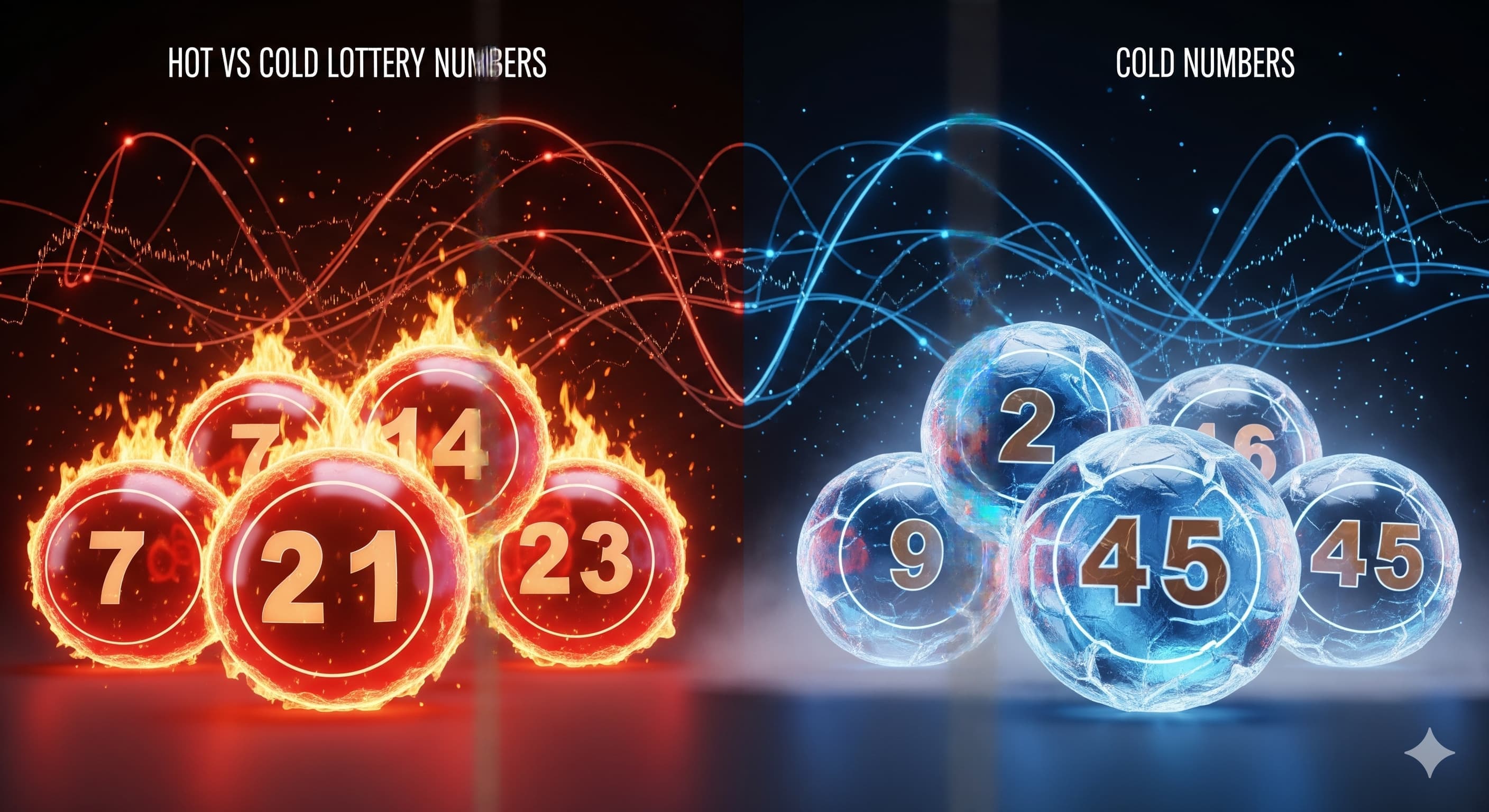
Every lottery player faces the same dilemma when filling out a ticket. Do you pick the numbers that have been winning constantly (riding the wave), or do you pick the numbers that haven't appeared in months (betting on the law of averages)?
In the world of lottery analysis, this is the battle of Hot vs. Cold.
At EuroLotto Predictor, we don't guess. We looked at the Eurojackpot draws since January 2022 (478 draws up to 11 September 2026). Lottery draws are designed to be independent: no draw is influenced by the ones before it. That is why no selection rule — neither "hot" nor "cold" — changes the probability that a number is drawn.
What is a "Hot" Number?
A "Hot" number is based on Frequency Analysis. It operates on the belief that lottery machines—while random—can exhibit short-term physical biases or "streaks." However, draws are designed to be independent and to give every number the same chance: a recent "streak" does not make a number more likely to come up in the next draw.
If Number 7 has been drawn 4 times in the last 10 weeks, a "Hot" strategy picks it again. That does not make it more likely to appear in the next draw — every draw is independent.
- The Logic (a common fallacy): "Success leaves clues."
- In Our App: You can test this using the "Hot Numbers (Recent)" slider in The Lab.
What is a "Cold" Number?
A "Cold" (or Due) number is one that hasn't appeared for a long time — say Number 49 after 6 months. This is often justified with the Law of Large Numbers, but that law only describes the average over a very large number of draws; there is no correction in the next draw, and a long-absent number is no more likely than any other.
- The Logic (a common fallacy): "What goes up must come down (and vice versa)."
- In Our App: This is the "Overdue Watch" strategy.
The Data: What Actually Happens?
What can be said about the Eurojackpot draws since January 2022 follows from the probabilities of 5 from 50, not from patterns in the results:
- There are always "Hot" numbers — inevitably: In 10 independent draws of 5 from 50, about 32.6 different numbers appear on average, some of them more than once. A number having come up once or twice does not make it "hot" — such repeats arise by themselves with 50 numbers and 5 drawn per draw, and say nothing about a higher chance.
- "Cold" numbers appear too — with the same chance as all others: A long absence says nothing about the next draw. Striking "clusters" are what chance produces with 50 numbers and 5 drawn per draw.
- "Repeaters": At least one number from the previous draw coming up again is expected in 42.34% of draws with 5 from 50 (1 − C(45,5)/C(50,5)) — exactly as often as chance dictates, not more.
A "Hybrid" Approach — as a selection rule, not an advantage
Neither strategy changes the probability that a line wins. What you can choose is a transparent rule for which numbers you play.
A common mix rule looks like this:
- 3 Hot Numbers (numbers that came up often recently)
- 1 Cold Number (to vary the selection)
- 1 Random/Neutral Number (To add entropy)
How to Apply This Strategy
You don't need a spreadsheet to calculate this. We built the EuroLotto Engine to do it for you.
- Go to Advanced Statistics (The Lab).
- Set Hot Numbers to 35%.
- Set Overdue Watch to 15%.
- Generate your tickets.
This configuration makes our engine build tickets that favour recently frequent numbers and mix in some long-absent ones. It changes which numbers you play — not the chances of those numbers.
Ready to test the math?
Discover data-driven predictions and strategies
Explore more from EuroLotto Prediction