
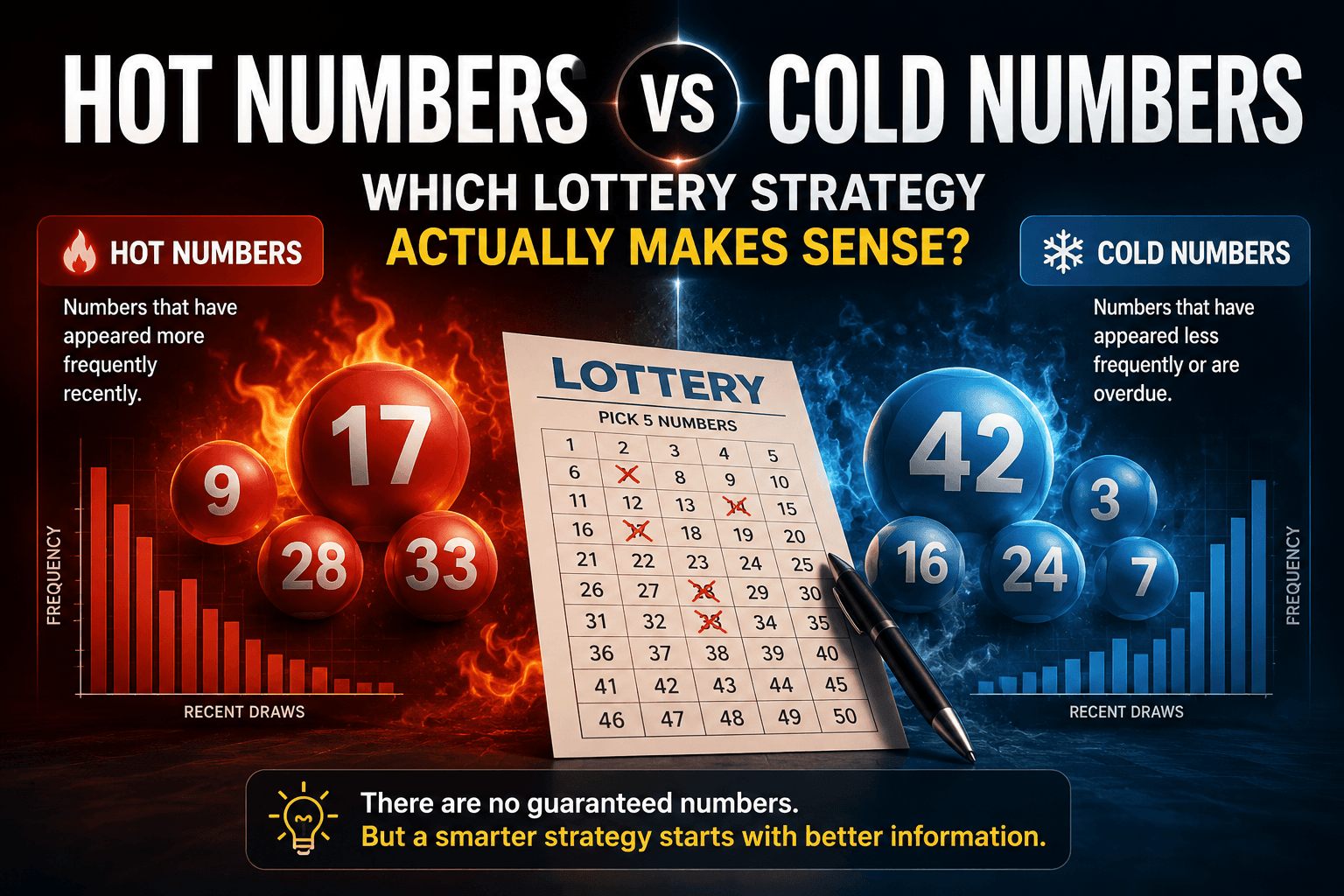
Many lottery players swear by hot numbers.
Others prefer cold numbers.
Some search specifically for overdue lottery numbers that "must be due" to appear soon.
These ideas have been around for decades and remain among the most searched lottery topics online.
But do hot and cold lottery numbers actually work?
The answer is more nuanced than most players expect.
What Are Hot Lottery Numbers?
Hot lottery numbers are numbers that have appeared more frequently than average in recent draws.
For example, if the number 17 has appeared several times over the last few weeks, many players would consider it a hot number.
The logic seems simple:
If a number is appearing often, maybe it will continue appearing.
Lottery websites regularly publish lists of hot numbers, and many players build their tickets around them.
What Are Cold Lottery Numbers?
Cold lottery numbers are the opposite.
These are numbers that have appeared less frequently than expected over a recent period.
For example, if the number 42 hasn't appeared for many draws, it may be classified as a cold number.
Players who prefer cold numbers usually believe:
If a number hasn't appeared recently, it may be more likely to appear soon.
This is closely related to the idea of overdue numbers.
The Problem With Both Theories
The challenge is that lottery draws are designed to be random.
A lottery machine does not know which numbers appeared last week.
It does not know which numbers are overdue.
Every draw starts fresh.
This means that neither hot numbers nor cold numbers possess any guaranteed predictive power by themselves.
A number that appeared yesterday can appear again tomorrow.
A number that hasn't appeared for months can remain absent for many more draws.
Randomness allows both outcomes.
Why Players Still See Patterns
Humans are naturally wired to find patterns.
When we see a number appear several times in a short period, it feels significant.
When a number disappears for months, it feels unusual.
But randomness often creates streaks naturally.
Consider flipping a coin.
Most people expect a sequence like:
Heads, tails, heads, tails, heads, tails.
In reality, random sequences frequently contain streaks such as:
Heads, heads, heads, heads, tails.
Lottery draws behave similarly.
Clustering and streaks are normal features of random systems.
The Gambler's Fallacy
One of the most common lottery mistakes is known as the gambler's fallacy.
This is the belief that past outcomes influence future independent outcomes.
For example:
The number 9 hasn't appeared in 20 draws, so it must be due.
Unfortunately, probability doesn't work that way.
The next draw doesn't compensate for previous draws.
A number that hasn't appeared recently is not automatically more likely to appear next.
This is why overdue numbers should be treated carefully.
So Are Hot Numbers Useless?
Not necessarily.
While hot numbers alone don't predict future draws, they can still be useful as part of a broader statistical framework.
Modern lottery models often examine:
- Frequency patterns
- Recency patterns
- Number pair relationships
- Distribution balance
- Sequential draw behavior
The key difference is that these signals are not used in isolation.
A professional approach combines multiple signals rather than relying on a single hot-number list.
Why Modern Lottery Analysis Uses Multiple Models
Imagine trying to predict the weather using only temperature.
You would ignore clouds, wind, humidity, and air pressure.
Lottery analysis faces a similar challenge.
A single metric rarely tells the whole story.
This is why advanced systems often combine many different statistical models.
Some models evaluate frequency.
Others look at number relationships.
Some measure distribution balance.
Others focus on crowd behavior and jackpot-sharing risk.
The goal is not to find a magical number.
The goal is to build a stronger overall ticket set.
The Smarter Question
Most players ask:
Which numbers are most likely to win?
A more useful question is:
How can I build a stronger ticket set?
The difference is important.
Winning numbers can never be known in advance.
But ticket structure, diversification, coverage, and overlap can be improved.
These factors are measurable.
And unlike lottery myths, they can actually be optimized.
Final Thoughts
Hot numbers are not guaranteed winners.
Cold numbers are not guaranteed winners.
Overdue numbers are not guaranteed winners.
All of these approaches focus on individual numbers.
The stronger approach is usually thinking about the entire ticket set.
Because in lottery play, success is rarely about finding one magical number.
It's about making smarter decisions across all of your numbers.
Try our strategies
Discover data-driven predictions and strategies
Explore more from EuroLotto Prediction