
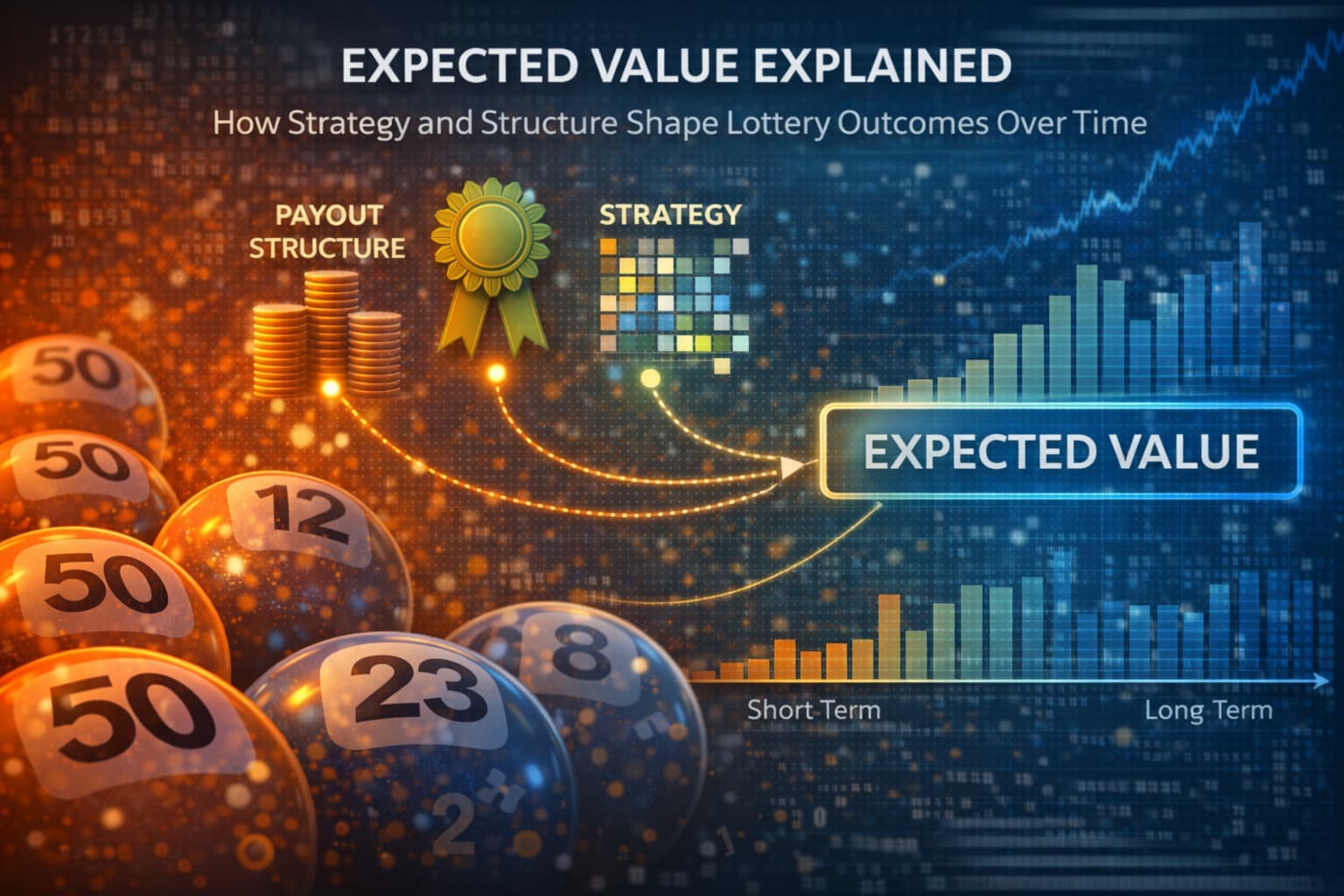
Most lottery discussions focus on which numbers to choose. A more fundamental question is how lottery games behave mathematically over time — and how strategy, structure, and scale influence outcomes.
To explore this, we start with one core concept: Expected Value (EV). EV does not predict results, but it describes what repeated play looks like when randomness unfolds over the long run.
Expected Value: A Long-Run Perspective
Expected Value (EV) represents the average outcome of a decision if it were repeated many times:
- EV = Σ (probability × payout) − ticket price: the mathematical baseline of a lottery ticket.
- EV reflects structure, not luck: individual outcomes vary, but averages converge over time.
- EV is not the whole story: variance, payout distribution, and jackpot sharing matter.
Expected value sets the baseline. Strategy determines how results accumulate around that baseline.
Variance: Why Identical Expected Values Can Feel Different
Expected value describes the long-run average under a given set of odds and payouts. Variance describes how widely individual results can fluctuate around that average — and in the short run, those fluctuations are what a player experiences.
If total spend, ticket-level odds and payout structure are held constant, two ways of allocating entries can have the same expected value while producing different short-run patterns.
- Concentrating entries into fewer draws can produce larger swings between sessions.
- Spreading entries across more draws can distribute those swings across a longer sequence of results.
Neither approach improves the underlying expected return simply because its short-run pattern feels different. The distinction is volatility, not a change in the lottery's odds.
This is where misreadings often begin. A good or bad stretch can be normal variance rather than evidence that expected value has changed. Short-run results are noisy, which is why simulation is useful for understanding the range of outcomes a structure can produce.
Variance also says nothing about which combination will be drawn next. How a player organises entries can change the distribution of their own short-run results; it cannot change the probability of an individual combination being selected by the lottery.
How Strategy Can Influence Outcomes (Without Changing the Odds)
Lottery probabilities are fixed. Strategy does not change the rules — but it can influence how outcomes are experienced over repeated play.
Here are three mechanisms where mathematics plays a role:
- Jackpot sharing effects: Choosing unpopular number structures does not increase winning probability, but it can reduce the likelihood of sharing a prize.
- Variance management: Pooling, repetition, or structured selection can smooth outcomes, making results more predictable over time.
- Structural exploration: Historical and simulated data can be examined for non-uniform patterns worth testing — without assuming predictability.
These effects rarely turn expected value positive, but they can influence effective EV, risk exposure, and payout concentration.
Why Simulation Matters More Than Belief
Human intuition struggles with randomness. Patterns feel meaningful even when they are not.
Simulation allows strategies to be tested at scale, revealing:
- how often a method outperforms a baseline,
- how volatile results are,
- and whether observed improvements persist over time.
This shifts the discussion from belief to evidence.
How EuroLotto Predictor Fits In
EuroLotto Predictor is designed as a probability laboratory — not a promise engine.
- Go to Advanced Statistics (The Lab).
- Enable Monte Carlo Simulation to establish a baseline.
- Compare structural or strategic variants against repeated random play.
Curious whether structure can meaningfully influence outcomes over time?
Explore strategies in The Lab
Explore The Lab
Discover data-driven predictions and strategies
Explore more from EuroLotto Prediction