
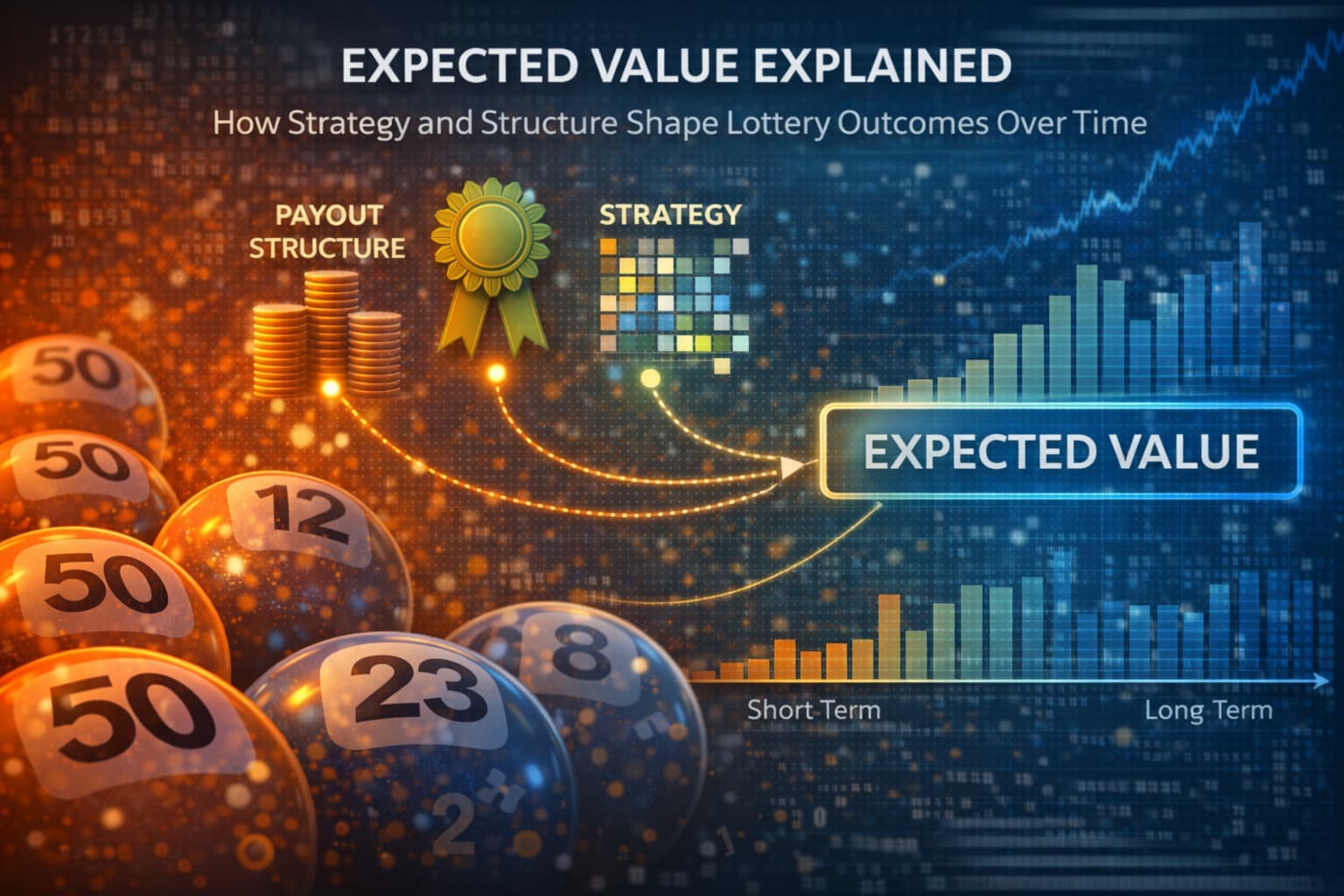
La mayoría de las discusiones sobre loterías se centran en qué números elegir. Una pregunta más fundamental es cómo se comportan los juegos de lotería matemáticamente a lo largo del tiempo — y cómo la estrategia, la estructura y la escala influyen en los resultados.
Para explorar esto, comenzamos con un concepto clave: Valor Esperado (VE). El VE no predice resultados, pero describe cómo se ve el juego repetido cuando la aleatoriedad se desarrolla a lo largo del tiempo.
Valor Esperado: Una Perspectiva a Largo Plazo
Valor Esperado (VE) representa el resultado promedio de una decisión si se repitiera muchas veces:
- VE = Σ (probabilidad × pago) − precio del billete: la base matemática de un billete de lotería.
- El VE refleja la estructura, no la suerte: los resultados individuales varían, pero los promedios convergen con el tiempo.
- El VE no es toda la historia: la varianza, la distribución de pagos y la compartición del bote importan.
El valor esperado establece la línea base. La estrategia determina cómo se acumulan los resultados alrededor de esa línea base.
Varianza: por qué valores esperados idénticos pueden sentirse diferentes
El valor esperado describe el promedio a largo plazo bajo un conjunto determinado de probabilidades y pagos. La varianza describe cuánto pueden fluctuar los resultados individuales alrededor de ese promedio — y, a corto plazo, esas fluctuaciones son lo que experimenta el jugador.
Si se mantienen constantes el gasto total, las probabilidades de cada boleto y la estructura de pagos, dos formas de distribuir las participaciones pueden tener el mismo valor esperado y, aun así, producir patrones diferentes a corto plazo.
- Concentrar participaciones en menos sorteos puede generar oscilaciones mayores entre sesiones.
- Distribuir participaciones entre más sorteos puede repartir esas oscilaciones a lo largo de una secuencia más extensa de resultados.
Ningún enfoque mejora el retorno esperado subyacente simplemente porque su patrón a corto plazo se sienta diferente. La diferencia está en la volatilidad, no en un cambio de las probabilidades de la lotería.
Aquí es donde suelen empezar las interpretaciones erróneas. Una buena o mala racha puede ser varianza normal en lugar de una prueba de que el valor esperado ha cambiado. Los resultados a corto plazo son ruidosos, por eso la simulación resulta útil para comprender el rango de resultados que puede producir una estructura.
La varianza tampoco dice nada sobre qué combinación se extraerá después. La forma en que un jugador organice sus participaciones puede cambiar la distribución de sus propios resultados a corto plazo; no puede cambiar la probabilidad de que la lotería seleccione una combinación concreta.
Cómo la Estrategia Puede Influir en los Resultados (Sin Cambiar las Probabilidades)
Las probabilidades de la lotería son fijas. La estrategia no cambia las reglas — pero puede influir en cómo se experimentan los resultados a lo largo del juego repetido.
Aquí hay tres mecanismos donde la matemática juega un papel:
- Efectos de compartición del bote: Elegir estructuras de números impopulares no aumenta la probabilidad de ganar, pero puede reducir la probabilidad de compartir un premio.
- Gestión de la varianza: Agrupar, repetir o seleccionar de manera estructurada puede suavizar los resultados, haciendo que sean más predecibles a lo largo del tiempo.
- Exploración estructural: Se pueden examinar datos históricos y simulados en busca de patrones no uniformes que valga la pena probar — sin asumir predictibilidad.
Estos efectos rara vez convierten el valor esperado en positivo, pero pueden influir en el VE efectivo, la exposición al riesgo y la concentración de pagos.
Por Qué la Simulación Importa Más Que la Creencia
La intuición humana lucha con la aleatoriedad. Los patrones parecen significativos incluso cuando no lo son.
La simulación permite probar estrategias a gran escala, revelando:
- con qué frecuencia un método supera una línea base,
- cuán volátiles son los resultados,
- y si las mejoras observadas persisten a lo largo del tiempo.
Esto desplaza la discusión de la creencia a la evidencia.
Cómo Encaja EuroLotto Predictor
EuroLotto Predictor está diseñado como un laboratorio de probabilidades — no como un motor de promesas.
- Ve a Estadísticas Avanzadas (El Laboratorio).
- Habilita la Simulación de Monte Carlo para establecer una línea base.
- Compara variantes estructurales o estratégicas contra el juego aleatorio repetido.
¿Tienes curiosidad sobre si la estructura puede influir de manera significativa en los resultados a lo largo del tiempo?
Explora estrategias en El Laboratorio
Explora El Laboratorio
Discover data-driven predictions and strategies
Explore more from EuroLotto Prediction