
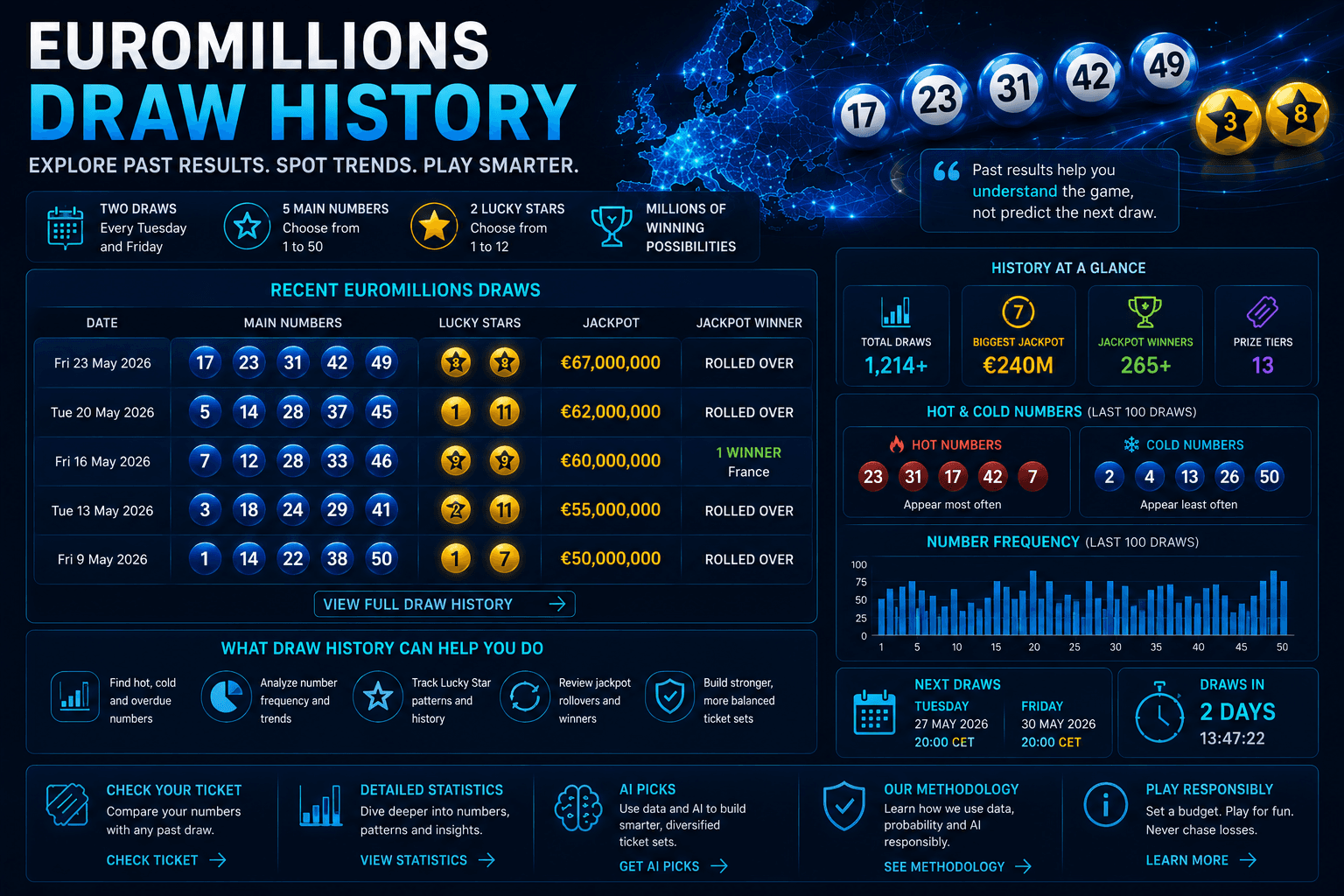
EuroMillions draw history is one of the most useful tools for understanding the game.
It shows previous winning numbers.
It shows past Lucky Stars.
It shows how jackpots moved over time.
And it gives players a clearer view of what happened in earlier draws.
But draw history is often misunderstood.
Some players look at past results and ask:
“Can this tell me what will happen next?”
That is the wrong question.
EuroMillions draw history cannot predict future winning numbers.
It cannot guarantee a pattern.
It cannot tell you which numbers must appear in the next draw.
But it can still be useful.
The better question is:
“How can past results help me understand the game and build better-structured tickets?”
That is where draw history becomes valuable.
The Quick Answer
EuroMillions draw history is a record of previous EuroMillions results.
It usually includes:
- draw date
- 5 main winning numbers
- 2 Lucky Stars
- jackpot information
- prize breakdown
- number trends
- previous result patterns
Draw history helps players review what happened before.
It can support number statistics, hot numbers, cold numbers, overdue numbers, and ticket structure.
But it should not be treated as a prediction tool.
The safe framing is simple:
“Past results help analysis. They do not predict future draws.”
Useful pages:
What EuroMillions Draw History Shows
A EuroMillions draw history page should make previous results easy to review.
Each past draw usually shows the winning numbers for that draw.
That means:
- 5 main numbers
- 2 Lucky Stars
It may also show the draw date, jackpot result, prize tiers, and whether the jackpot was won or rolled over.
This makes draw history useful for several types of users.
Some players want to check an old ticket.
Some want to compare recent draws.
Some want to look at number frequency.
Some want to review past jackpot movement.
Some want to understand whether certain numbers appeared recently.
All of these are valid uses.
But they are historical uses.
They are not guarantees.
Latest Results vs Draw History
Latest results and draw history are related, but they are not the same.
Latest results show the newest EuroMillions draw.
Draw history shows previous draws over time.
Latest results answer:
“What happened in the most recent draw?”
Draw history answers:
“What has happened across many previous draws?”
Both are useful.
A player may first check the latest result.
Then they may look at draw history to understand past numbers, previous Lucky Stars, or jackpot movement.
That is why the checker, latest results, statistics, and draw history pages should all connect naturally.
Useful pages:
Why Players Search for Draw History
Players search for EuroMillions draw history for several reasons.
They may want to check an older ticket.
They may want to compare Tuesday and Friday results.
They may want to see past winning numbers.
They may want to look at number trends.
They may want to review previous jackpots.
They may want to study hot, cold, or overdue numbers.
The common intent is clear:
“Show me what happened before.”
This is useful because EuroMillions is not only a single draw.
It is a long sequence of draws.
Draw history gives that sequence context.
Checking Old Tickets
One practical reason to use draw history is checking an old ticket.
Maybe you forgot to check a ticket after the draw.
Maybe you found an old ticket later.
Maybe you want to confirm which draw date it belongs to.
In that case, draw history helps you find the correct result.
Before checking an older ticket, confirm:
- the draw date
- the draw day
- the 5 main numbers
- the 2 Lucky Stars
- whether your ticket was valid for that draw
Then use a checker if available.
Useful page:
Draw History and Number Frequency
Draw history is the foundation for number frequency.
To calculate how often numbers appeared, you need past draw results.
For main numbers, frequency means counting how often each number from 1 to 50 appeared.
For Lucky Stars, frequency means counting how often each Lucky Star from 1 to 12 appeared.
This can support statistics such as:
- most common numbers
- least common numbers
- hot numbers
- cold numbers
- Lucky Star frequency
- recent number trends
But frequency should be understood correctly.
A number that appeared often in the past is not guaranteed to appear again soon.
It simply appeared often in the selected history.
Draw History and Hot Numbers
Hot numbers are calculated from draw history.
A hot number is usually a number that appeared more often than others in a selected period.
That period could be:
- all available draws
- the last 100 draws
- the last 50 draws
- the last 20 draws
- a custom time window
The time window matters.
A number may be hot over the full draw history but not hot recently.
Another number may be hot in recent draws but average over the full history.
So whenever you look at hot numbers, ask:
“Hot over which period?”
That makes the analysis clearer.
Useful page:
Draw History and Cold Numbers
Cold numbers also come from draw history.
A cold number is usually a number that appeared less often than others in a selected period.
Some players avoid cold numbers.
Others like them because they feel underused.
But neither view should be treated as certainty.
Cold numbers are not guaranteed to stay cold.
They are also not guaranteed to appear soon.
They simply appeared less often in the selected history.
That can be useful information.
But it is not a prediction.
Draw History and Overdue Numbers
Overdue numbers are different from hot and cold numbers.
An overdue number is based on the gap since the number last appeared.
It answers the question:
“How many draws have passed since this number last appeared?”
A number can be hot and overdue at the same time.
For example, it may have appeared many times historically but not in recent draws.
That is why overdue analysis should not be mixed up with frequency analysis.
They measure different things.
Draw history supports both.
But both should be used carefully.
Draw History and Lucky Stars
Lucky Stars should always be analyzed separately from main numbers.
Main numbers come from 1 to 50.
Lucky Stars come from 1 to 12.
Because the pools are different, the statistics are different.
A Lucky Star will naturally appear more often than a main number because there are fewer Lucky Stars.
That means main number history and Lucky Star history should not be mixed together.
A good draw history or statistics page should separate:
- main number results
- Lucky Star results
- main number frequency
- Lucky Star frequency
- main number gaps
- Lucky Star gaps
This makes the analysis more accurate.
Can Draw History Predict Future Numbers?
No.
Draw history cannot predict future EuroMillions numbers.
This is the most important point.
Past results are useful because they show what happened.
But the next draw is still random.
A number that appeared last week does not become more or less guaranteed next week.
A number missing for many draws does not have to return.
A hot number does not have to stay hot.
A cold number does not have to stay cold.
Draw history is data.
It is not a promise.
The Gambler’s Fallacy Problem
A common mistake is thinking that a number is “due.”
For example:
“This number has not appeared for a long time, so it must appear soon.”
That sounds logical.
But random draws do not work like a queue.
A number does not wait for its turn.
Each draw starts fresh.
This mistake is often called the gambler’s fallacy.
Draw history can make this mistake more tempting because the data looks meaningful.
That is why a responsible statistics page should always remind players:
“Past results do not guarantee future results.”
What Draw History Can Actually Help With
Draw history cannot predict the next result.
But it can help with structure.
It can help players understand:
- which numbers appeared recently
- which numbers appeared often
- which numbers appeared less often
- which Lucky Stars appeared more often
- how jackpots moved over time
- how number patterns looked in past draws
- how their own ticket set compares with historical structures
This can support better ticket-building.
Not better prediction.
That difference matters.
Draw History and Ticket Structure
If you use draw history properly, it can help you build more thoughtful tickets.
For example, draw history can help you avoid:
- relying only on birthdays
- choosing too narrow a number range
- repeating the same Lucky Stars too often
- building several tickets that look too similar
- ignoring number spread
- overusing only hot numbers
- overusing only overdue numbers
This does not make the ticket more likely to win the jackpot.
But it can make the ticket set more structured.
That is a safer and more honest use of data.
Where AI Picks Fit In
AI Picks can use draw history as one input.
But AI should not use draw history to claim it can predict the next result.
That would be misleading.
The better use is ticket structure.
AI can combine draw history with other checks, such as:
- number spread
- high and low balance
- odd and even balance
- Lucky Star distribution
- overlap between multiple tickets
- hot and cold number inputs
- overdue number inputs
- common player pattern avoidance
This can help create more diversified ticket sets.
But it cannot guarantee winning numbers.
The safe framing is:
“AI cannot predict winning numbers, but it can help structure and diversify ticket sets.”
Try:
Draw History Before the Draw
Before a draw, players may use history to review number trends.
This can be useful if it helps create a more balanced ticket set.
For example, a player may want to avoid choosing numbers only from one range.
Or they may want to include a mix of number types.
Or they may want to avoid repeating too many numbers across multiple tickets.
Draw history can support those choices.
But it should never be used to say:
“These numbers will win.”
The right framing is:
“These numbers help create a more structured set.”
Draw History After the Draw
After a draw, history helps place the latest result in context.
You can see whether the numbers appeared recently.
You can compare the latest Lucky Stars with previous ones.
You can review jackpot movement.
You can check whether any numbers became more frequent or more overdue.
This can make the result more interesting to study.
But one draw does not prove a pattern.
A single result is just one result.
The next draw starts fresh.
Draw History and Multiple Tickets
Draw history becomes especially useful when you play multiple tickets.
A single ticket is one combination.
A group of tickets is a set.
If you build a set, you may want to compare it against historical structures.
For example:
- Are your numbers too clustered?
- Are your Lucky Stars too repetitive?
- Are too many lines date-based?
- Are several tickets structurally similar?
- Is the set spread across the full number range?
Draw history cannot guarantee success.
But it can help you avoid weak ticket habits.
What a Good Draw History Page Should Include
A useful EuroMillions draw history page should be clear and practical.
It should include:
- previous draw dates
- 5 main winning numbers
- 2 Lucky Stars
- jackpot information
- prize breakdown links
- checker links
- statistics links
- clear navigation by date
- safe language around prediction
It should help players move naturally from past results to checking, statistics, and structured ticket building.
Useful pages:
Common Mistakes With Draw History
Players often make the same mistakes.
They assume past results predict future results.
They think overdue numbers must appear soon.
They think hot numbers are guaranteed to continue.
They mix main numbers and Lucky Stars.
They ignore the time window.
They use only one statistic.
They build tickets from patterns without checking the full set.
They chase after a losing draw.
A better approach is calmer:
“Use draw history to understand the game, not to force a result.”
A Simple Way to Use Draw History
A simple draw-history process looks like this.
First, check the latest result.
Then review previous results.
Next, look at statistics for context.
Then build tickets with structure.
Finally, check your ticket after the next draw.
That creates a simple cycle:
- review results
- understand history
- build a structured ticket set
- play within budget
- check the outcome
- repeat responsibly
This is much better than treating past results as a prediction machine.
Responsible Use of Draw History
Draw history can make lottery play more interesting.
It can also make it feel more analytical.
But it should not create false confidence.
No result pattern removes randomness.
No statistic guarantees a future number.
No AI tool knows the next draw.
So draw history should be used for clarity, not certainty.
A good rule is:
“If a statistic helps you build a better ticket set, it is useful. If it makes you think a win is guaranteed, it is misleading.”
Final Thoughts
EuroMillions draw history is valuable because it shows what happened before.
It helps players review past winning numbers.
It supports statistics such as hot numbers, cold numbers, overdue numbers, and Lucky Star trends.
It helps players check older tickets.
It gives context to the latest draw.
And it can support better ticket structure.
But it does not predict the next draw.
That is the key point.
The smartest use of draw history is not:
“Which number must come next?”
The smarter question is:
“How can this history help me build a more structured ticket set?”
That is where draw history, statistics, and AI Picks work together.
Not as prediction.
As structure.
FAQ
What is EuroMillions draw history?
EuroMillions draw history is a record of previous EuroMillions results, including main numbers, Lucky Stars, draw dates, and sometimes jackpot or prize information.
What does EuroMillions draw history show?
It usually shows past winning numbers, Lucky Stars, draw dates, and previous results over time.
Can draw history predict future EuroMillions numbers?
No. Draw history can support analysis, but it cannot predict future winning numbers.
What is the difference between latest results and draw history?
Latest results show the newest draw. Draw history shows previous draws over time.
Can I use draw history to check an old ticket?
Yes. Draw history can help you find the correct past result for a specific draw date.
Does a hot number from draw history have a better chance next time?
Not necessarily. Hot numbers describe past frequency, not future certainty.
Are overdue numbers guaranteed to appear?
No. Overdue numbers show long gaps since last appearance, but they are not guaranteed to appear soon.
Can AI use draw history?
Yes. AI can use draw history as one input to help structure ticket sets, but it cannot predict guaranteed winning numbers.
Where can I view EuroMillions draw history?
You can view past results on the complete lottery results archive.
View EuroMillions Results
Discover data-driven predictions and strategies
Explore more from EuroLotto Prediction