
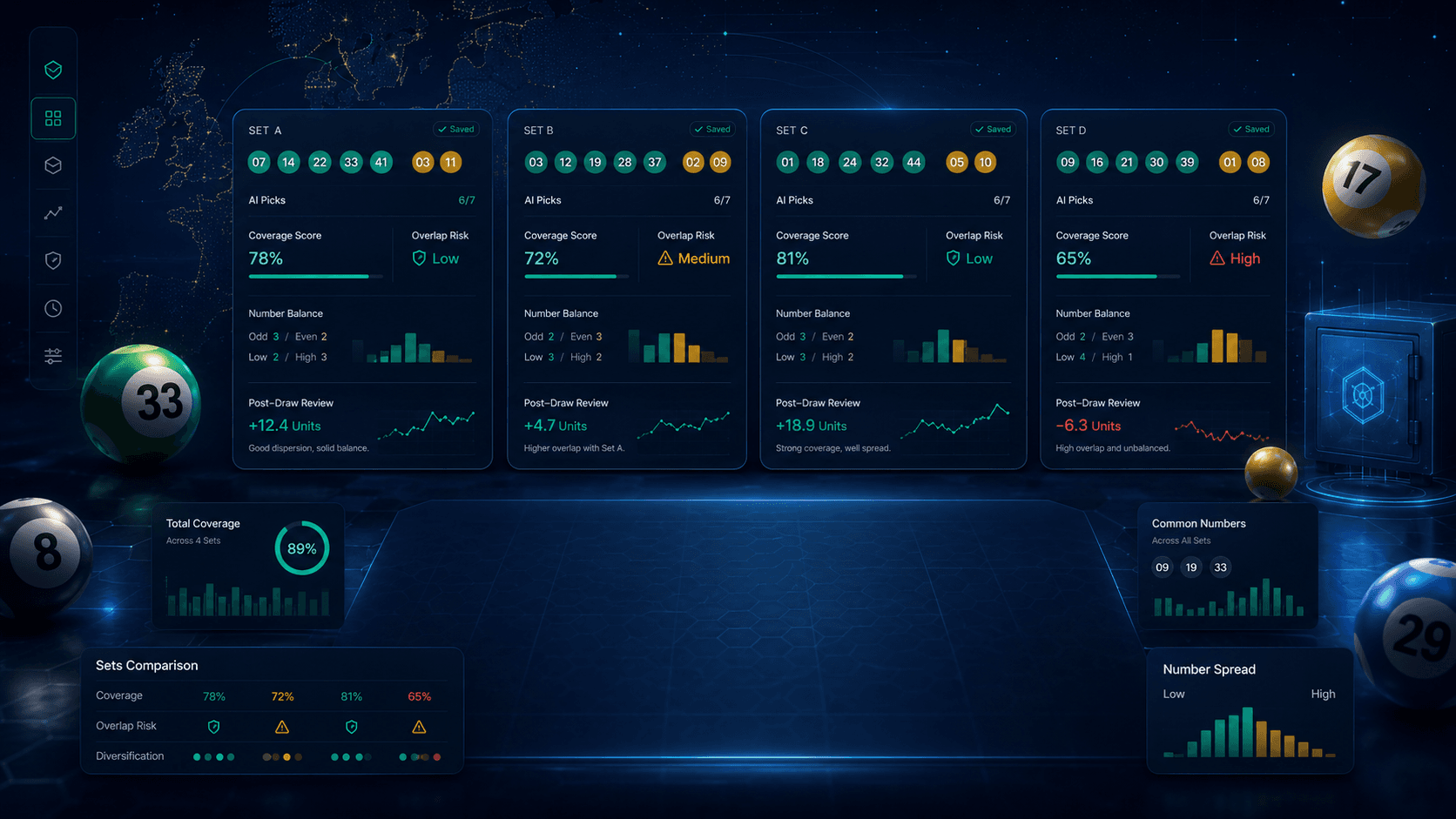
Most lottery players compare numbers only after the draw.
They look at the winning numbers.
They look at their ticket.
Then they ask:
“Did I win?”
That is the normal way to check a lottery ticket.
But if you play multiple tickets, there is another useful question to ask before the draw:
“Which ticket set is better structured?”
That is where comparing multiple lottery ticket sets becomes useful.
A ticket set is more than a list of random lines.
It can be balanced or unbalanced.
It can be diversified or repetitive.
It can cover different number ranges or keep repeating the same ideas.
And if you use AI-generated picks, comparing sets becomes even more important.
Because AI should not be judged by whether it predicts the next draw.
It should be judged by whether it helps build better ticket structure.
The Quick Answer
To compare multiple lottery ticket sets, look at how each set is built.
A useful comparison should check:
- number coverage
- repeated numbers
- ticket overlap
- high and low balance
- odd and even balance
- Lucky Star distribution
- birthday-number bias
- common player patterns
- post-draw review results
- whether each ticket adds something useful
The goal is not to find a guaranteed winning set.
The goal is to find the better-structured set.
The safest framing is:
“AI cannot predict winning numbers, but it can help structure and diversify ticket sets.”
Useful page:
What Is a Lottery Ticket Set?
A lottery ticket set is a group of ticket lines.
For example, if you generate six EuroMillions tickets, those six lines form one set.
If you generate another six tickets, that becomes a second set.
Each individual line is one possible combination.
But the set is the full group.
That matters because a group can be reviewed in ways that one ticket cannot.
One ticket can only be checked as one combination.
A set can be compared for structure.
Why Comparing Sets Matters
Buying or generating more tickets does not automatically mean you are playing smarter.
More tickets create more combinations.
But they can also repeat too many of the same ideas.
For example, a weak set may include:
- several tickets with the same Lucky Stars
- too many low numbers
- too many birthday numbers
- repeated numbers across many lines
- similar number patterns
- narrow range coverage
- too much overlap between tickets
That means the set may look larger than it really feels structurally.
You have more lines.
But the lines may not add enough new coverage.
Comparing sets helps reveal that.
One Ticket vs Multiple Sets
One ticket is simple.
It is one guess.
A group of tickets is more complex.
And multiple groups of tickets are even more interesting.
Imagine you generate three different ticket sets.
Each set has six lines.
Now you can compare them.
You can ask:
- which set covers more of the number range?
- which set repeats fewer numbers?
- which set has better Lucky Star spread?
- which set has less overlap?
- which set looks less date-heavy?
- which set is easier to review after the draw?
This is exactly the kind of task the Virtual Vault is built for.
Compare Coverage First
Coverage is one of the most important comparison points.
Coverage means how much useful variety a ticket set creates.
It does not mean covering every possible combination.
That would be impossible for normal players.
Instead, coverage asks:
“Does this set spread its choices intelligently?”
A set with better coverage usually has:
- broader number spread
- less unnecessary repetition
- better Lucky Star variety
- fewer duplicated structures
- more difference between ticket lines
Coverage does not guarantee a prize.
But it helps avoid wasting too much of the set on similar combinations.
Compare Repeated Numbers
Repeated numbers are not always bad.
Some repetition is normal.
But too much repetition can make a set narrow.
For example, if one number appears in almost every ticket line, the set depends heavily on that number.
That may be intentional.
But often it happens by accident.
When comparing sets, ask:
- which numbers repeat most often?
- does one set repeat fewer numbers than another?
- are repeated numbers spread sensibly?
- are some number ranges ignored completely?
- does each ticket line add something new?
A better set does not need zero repetition.
It needs controlled repetition.
Compare Ticket Overlap
Ticket overlap is different from repeated numbers.
Overlap looks at how similar ticket lines are to each other.
Two tickets may share several numbers.
Or they may use the same Lucky Stars.
Or they may follow the same structure.
A set with too much overlap may be less useful than it looks.
When comparing sets, ask:
“Are these tickets doing different work, or repeating the same idea?”
A strong ticket set should usually avoid too much similarity between lines.
That is especially important when playing multiple tickets.
Compare Number Spread
Number spread means how widely the set uses the available number pool.
For EuroMillions, main numbers run from 1 to 50.
If one set uses mostly numbers from 1 to 31, it may be too date-heavy.
If another set uses the full number range more evenly, it may be more diversified.
A simple number spread comparison asks:
- does the set include low numbers?
- does it include middle numbers?
- does it include higher numbers?
- are numbers clustered too tightly?
- does the set use the full pool?
The goal is not perfect distribution.
The goal is avoiding accidental narrowness.
Compare High and Low Balance
High and low balance is another simple comparison.
A single ticket can be high-heavy or low-heavy.
That is fine.
But across a full set, it is useful to check whether the set leans too strongly in one direction.
For example, Set A may use mostly low numbers.
Set B may use a more balanced mix.
Set C may use mostly high numbers.
The better set depends on your strategy.
But if one set is narrow by accident, it may be worth refreshing.
Compare Odd and Even Balance
Odd and even balance is also useful.
Lottery draws can produce many different odd/even patterns.
There is no perfect formula.
But if a full ticket set is heavily tilted toward odd or even numbers, the structure may be narrow.
When comparing sets, ask:
- does one set have a better mix?
- do several tickets repeat the same odd/even pattern?
- is the set accidentally one-sided?
- does the structure feel diversified?
Again, this is not prediction.
It is a structure check.
Compare Lucky Star Distribution
Lucky Stars matter.
For EuroMillions, you need both Lucky Stars for the jackpot.
That means Lucky Star distribution should be part of every set comparison.
Many players focus mainly on the main numbers.
But if you compare ticket sets properly, you should also ask:
- are Lucky Stars repeated too often?
- does one set use more Lucky Star variety?
- are the same pairs appearing again and again?
- are favourite Lucky Stars overused?
- does the set treat Lucky Stars as part of the strategy?
A strong set should not ignore Lucky Stars.
Compare Birthday-Number Bias
Birthday-number bias happens when many numbers come from dates.
That usually means numbers from 1 to 31.
There is nothing wrong with personal numbers if you play casually.
But if you are comparing ticket sets for structure, birthday bias is important.
A date-heavy set may ignore numbers from 32 to 50.
It may also create combinations that are more common among other players.
That does not make those numbers less likely to be drawn.
But if many players share similar date-based combinations, prizes may be shared more often if those combinations win.
So when comparing sets, ask:
“Which set relies less on common human patterns?”
Compare Common Player Patterns
Some lottery patterns are very popular.
For example:
- simple sequences
- repeated shapes
- all low numbers
- favourite numbers reused every draw
- visual patterns from ticket slips
- the same Lucky Stars every time
These patterns are not less likely to be drawn.
But they may be chosen by many players.
That matters because shared prizes can reduce individual payout if a popular combination wins.
A better ticket set may avoid obvious patterns.
This is not because it predicts better.
It is because it is more deliberate.
Compare Random Sets
Random ticket sets can be useful.
They avoid emotional picking.
They do not care about birthdays.
They can create unexpected combinations.
But random does not always mean well structured.
Two random sets can be very different.
One may have broad coverage.
Another may repeat several numbers.
One may have good Lucky Star variety.
Another may use the same stars too often.
So even random sets are worth comparing.
Random means random.
It does not mean optimized.
Compare AI-Generated Sets
AI-generated ticket sets should also be compared.
AI can create structured sets quickly.
But the output should still be reviewed.
A responsible AI lottery tool should not say:
“This set will win.”
It should help create a set with better structure.
When comparing AI-generated sets, ask:
- which set has better coverage?
- which set has less overlap?
- which set uses Lucky Stars better?
- which set avoids date bias?
- which set is easier to review after the draw?
Useful pages:
Compare Before the Draw
Before the draw, comparison is about structure.
There is no result yet.
So the useful questions are:
- which set is more balanced?
- which set has better coverage?
- which set has less overlap?
- which set uses the number pool more broadly?
- which set has better Lucky Star spread?
- which set avoids obvious patterns?
This helps you decide which set to save.
It does not tell you which set will win.
That difference is important.
Compare After the Draw
After the draw, comparison becomes a review.
Now you can look at how saved sets performed against the official result.
You can compare:
- best-performing line
- matched numbers
- matched Lucky Stars
- near-misses
- whether one set had broader coverage
- whether one set produced a closer match
- whether a set should be refreshed
This is where the Virtual Vault becomes very useful.
It lets you save sets before the draw and review them after.
Useful page:
Why Post-Draw Comparison Matters
Post-draw comparison helps you learn from saved sets.
Not to predict the next draw.
But to understand what happened.
If one set had too much overlap, that may be visible after review.
If another set had better coverage, that may also be visible.
If all sets repeated the same Lucky Stars, that tells you something about your selection process.
The goal is not to chase the result.
The goal is to improve the next set-building process.
What a Good Comparison Tool Should Show
A useful comparison tool should make differences clear.
It should show:
- total tickets in each set
- number coverage
- repeated numbers
- overlap score
- Lucky Star distribution
- high and low balance
- odd and even balance
- best post-draw match
- near-miss notes
- refresh recommendation
It should also avoid prediction language.
The best tool does not say:
“This set will win.”
It says:
“This set is more diversified and less repetitive.”
That is the safer promise.
The Role of the Virtual Vault
The Virtual Vault gives ticket set comparison a home.
Instead of generating numbers and losing track of them, you can save sets.
Then you can review them later.
This creates a simple process:
- generate a set
- compare structure
- save the set
- wait for the draw
- review performance
- refresh if needed
That is much stronger than choosing new numbers every time with no memory.
The Role of AI Picks
AI Picks can help create multiple candidate sets.
For example, you might generate one set focused on broad coverage.
Another set focused on balanced number ranges.
Another set with more Lucky Star variety.
Then the Virtual Vault can help save and compare them.
AI can help with structure.
The Vault helps with memory and review.
But neither one predicts the winning numbers.
The safe message remains:
“AI cannot predict winning numbers, but it can help structure and diversify ticket sets.”
The Role of the Checker
A lottery ticket checker is still useful.
After the draw, the checker helps compare numbers with the official result.
But a checker usually focuses on one ticket or one result.
The Virtual Vault adds a set-level view.
The checker answers:
“Did these numbers match?”
The Vault asks:
“How did this saved set perform?”
Both are useful.
Useful page:
Example: Comparing Two Sets
Imagine two players each have six tickets.
Set A has many birthday numbers and repeats the same Lucky Stars several times.
Set B uses a wider number range and spreads Lucky Stars more evenly.
Both sets still face random odds.
Neither set is guaranteed to win.
But Set B may be better structured.
Why?
Because it has broader coverage and less repetition.
That is what comparison helps reveal.
Example: Comparing Three AI Sets
Imagine you generate three AI ticket sets.
Set A has the best high and low balance.
Set B has the least overlap.
Set C has the strongest Lucky Star spread.
Which one is best?
That depends on your goal.
If you want less overlap, Set B may be strongest.
If you want better Lucky Star variety, Set C may be better.
If you want overall balance, Set A may be useful.
The point is that comparison makes the choice more transparent.
Do Not Compare Only the Best Line
A common mistake is comparing sets only by the best single ticket.
That can be misleading.
A set should be judged as a group.
One line may look good.
But the rest of the set may be weak.
A better comparison asks:
- how strong is the full set?
- does every ticket add something useful?
- is coverage broad?
- is overlap controlled?
- is Lucky Star distribution sensible?
The set matters.
Not only the best line.
Do Not Compare Only Wins
Another mistake is comparing only winning outcomes.
Most lottery tickets do not win major prizes.
That is normal.
So if you only compare wins, you may miss the structure.
A useful comparison should also review non-winning sets.
It can still show whether a set was diversified.
It can still show whether it had near-misses.
It can still show whether the set should be refreshed.
This makes the review more useful.
Comparing Sets Does Not Change the Odds
This point is important.
Comparing ticket sets does not make the lottery predictable.
It does not change the jackpot odds of each individual line.
Every valid lottery line still has the same chance before the draw.
Comparison helps with structure.
It does not guarantee outcomes.
That is why the right promise is not:
“Compare sets to find the winner.”
The right promise is:
“Compare sets to build better structure.”
Why Structure Still Matters
If comparison does not guarantee a win, why bother?
Because structure is still the part you can control.
You cannot control the draw.
But you can control whether your tickets are repetitive.
You can control whether you rely only on birthdays.
You can control whether Lucky Stars are ignored.
You can control whether your set has broad or narrow coverage.
That makes structure useful.
Even without prediction.
A Simple Set Comparison Checklist
Before saving a ticket set, ask:
- Does this set fit my budget?
- Does it cover the number range sensibly?
- Are low and high numbers balanced?
- Are odd and even numbers balanced?
- Are numbers repeated too heavily?
- Do tickets overlap too much?
- Are Lucky Stars spread well?
- Is the set too date-heavy?
- Does each ticket add something different?
- Am I avoiding prediction claims?
This checklist can make ticket selection more thoughtful.
Responsible Play Comes First
Comparing sets should not push you to spend more.
It should help you make better use of the tickets you already planned to play.
Start with a fixed budget.
Then choose the number of lines.
Then compare sets inside that budget.
Do not use comparison as a reason to chase losses.
Do not treat a close match as proof that a win is coming.
Lottery should stay entertainment.
Final Thoughts
Comparing multiple lottery ticket sets is not about predicting the next draw.
It is about understanding structure.
A useful comparison looks at coverage, overlap, number spread, Lucky Stars, balance, and post-draw review.
This is especially valuable when you use AI Picks or play multiple ticket lines.
AI can help generate structured sets.
The Virtual Vault can help save and compare them.
The checker can help review the official result after the draw.
Together, they create a more complete routine.
But the key message stays simple:
“AI cannot predict winning numbers, but it can help structure and diversify ticket sets.”
And comparing sets is one of the best ways to see that structure clearly.
FAQ
What is a lottery ticket set?
A lottery ticket set is a group of ticket lines played or saved together.
Why compare multiple lottery ticket sets?
Comparing sets helps you see which set has better coverage, less overlap, stronger balance, and better structure.
Can comparing ticket sets predict winning numbers?
No. Comparing sets cannot predict winning numbers. It only helps evaluate structure.
What is ticket set coverage?
Ticket set coverage means how well a group of tickets spreads across the number pool without too much unnecessary repetition.
What is ticket overlap?
Ticket overlap happens when multiple ticket lines share too many numbers or patterns.
Can AI compare lottery ticket sets?
Yes. AI can help compare structure, coverage, overlap, balance, and diversification. It cannot predict guaranteed winning numbers.
Is a random ticket set always well structured?
No. Random sets can still have repeated numbers, clusters, weak Lucky Star distribution, and too much overlap.
How does the Virtual Vault help compare sets?
The Virtual Vault lets you save ticket sets before the draw and review how they performed after the official result.
Where can I compare and save ticket sets?
You can use the Virtual Vault to save and review structured ticket sets.
Compare Sets in the Virtual Vault
Discover data-driven predictions and strategies
Explore more from EuroLotto Prediction