
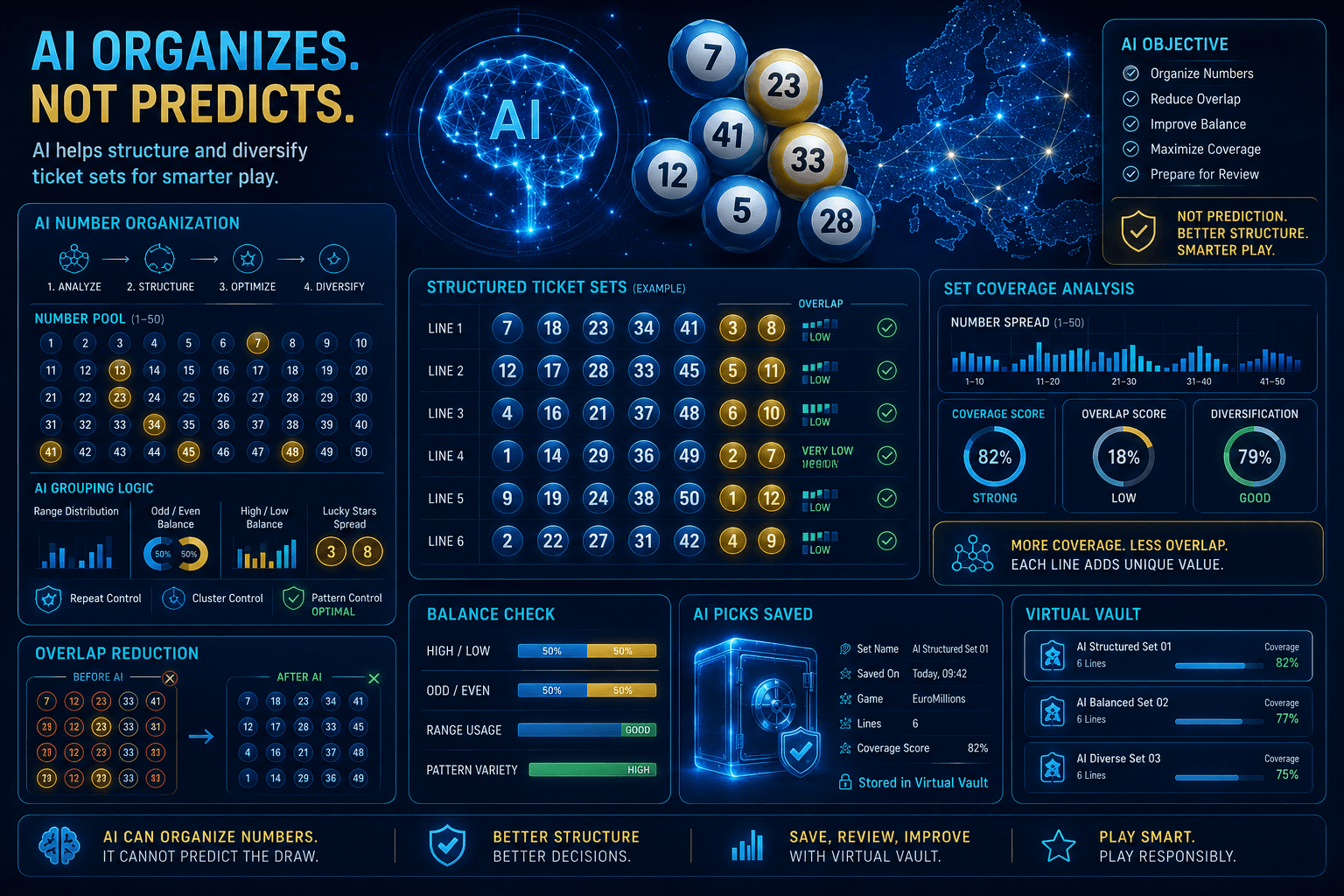
AI is often discussed in lottery strategy.
Some players ask whether AI can predict winning numbers.
Others ask whether AI can find hidden patterns.
But the better question is simpler:
“Can AI help organize lottery numbers better?”
That is a much safer and more useful question.
AI cannot predict lottery winning numbers.
It cannot know the next official draw.
It cannot guarantee a prize.
It cannot remove randomness.
But AI can help with something practical:
“Organizing lottery numbers into better-structured ticket sets.”
That means less repetition.
Better number spread.
More useful coverage.
More balanced ticket lines.
And clearer review after the draw.
This is where AI can be useful.
Not as a prediction machine.
As a structure tool.
The Quick Answer
Yes, AI can help organize lottery numbers.
But it should not be used as a prediction promise.
AI can help with:
- grouping numbers into ticket sets
- reducing unnecessary overlap
- improving number spread
- balancing high and low numbers
- balancing odd and even numbers
- improving Lucky Star distribution
- avoiding too much birthday-number bias
- comparing multiple ticket sets
- preparing sets for Virtual Vault review
The key message is:
“AI cannot predict winning numbers, but it can help structure and diversify ticket sets.”
Useful pages:
Why “Organize” Is Better Than “Predict”
Prediction is the wrong promise for lottery tools.
Prediction suggests that the tool knows what will happen next.
That is misleading.
Lottery draws are random.
No honest AI system can know the next winning numbers in advance.
But organization is different.
Organization focuses on the part you can control:
- how your tickets are built
- how numbers are spread
- how much tickets overlap
- how Lucky Stars are used
- how sets are saved and reviewed
That makes “organize” a much better word than “predict.”
It is more honest.
It is more useful.
And it fits how AI can actually help.
What AI Can Do With Lottery Numbers
AI can process many combinations quickly.
It can compare ticket lines.
It can detect repeated structures.
It can identify whether a set is too narrow.
It can flag when too many tickets use the same numbers.
It can highlight weak Lucky Star distribution.
It can help build a more balanced set.
This does not mean the set will win.
It means the set can be more deliberate.
That is the real value.
What AI Cannot Do
AI cannot guarantee winning numbers.
It cannot see the future.
It cannot know the official draw result before it happens.
It cannot make a jackpot likely.
It cannot prove that hot numbers will continue.
It cannot prove that overdue numbers will return.
It cannot remove the risk of losing.
Any tool that suggests otherwise should be treated carefully.
A responsible AI lottery tool should be clear:
“AI helps structure tickets. It does not predict the draw.”
AI and Ticket Sets
AI becomes more useful when you think in ticket sets.
One ticket is just one combination.
But several tickets can work together.
A ticket set can be reviewed for structure.
For example, AI can ask:
- do these tickets repeat too many numbers?
- are the tickets too similar?
- does the set use the full number range?
- are Lucky Stars spread sensibly?
- are high and low numbers balanced?
- are odd and even numbers balanced?
- does each ticket add something useful?
These are structure questions.
They are exactly where AI can help.
AI and Number Spread
Number spread means how widely numbers are distributed across the available pool.
For EuroMillions, main numbers run from 1 to 50.
If most ticket lines use numbers from 1 to 31, the set may be date-heavy.
That often happens when players use birthdays and anniversaries.
AI can notice this.
It can help include numbers from the full range.
This does not make the ticket more likely to win.
But it can make the set less narrow.
AI and High / Low Balance
A good ticket set should usually avoid being accidentally one-sided.
If all tickets use mostly low numbers, higher numbers may be underused.
If all tickets use mostly high numbers, lower numbers may be underused.
AI can check the full set and ask:
“Is this ticket set too low-heavy or too high-heavy?”
This kind of check is simple.
But it is easy to miss manually when several tickets are involved.
AI can make it visible.
AI and Odd / Even Balance
Odd and even balance is another structure signal.
There is no perfect odd/even formula.
A valid lottery ticket can have many different patterns.
But if every ticket in a set repeats the same odd/even structure, the set may be narrow.
AI can compare all lines and identify whether the set is too repetitive.
The goal is not perfection.
The goal is useful variation.
AI and Ticket Overlap
Ticket overlap is one of the biggest problems in multi-ticket play.
Overlap happens when several tickets share too many numbers or patterns.
Some overlap is normal.
But too much overlap can reduce useful coverage.
AI can help measure overlap.
It can show:
- which numbers repeat most often
- which ticket lines are too similar
- whether Lucky Stars repeat too much
- whether some numbers dominate the set
- whether each ticket adds something new
That is a strong use case for AI.
AI and Coverage
Coverage means how well a group of tickets spreads across the number space.
Coverage does not mean covering every possible combination.
That is impossible for normal players.
It means making better use of the tickets you already planned to play.
AI can help improve coverage by reducing unnecessary repetition.
It can also help compare different sets.
For example, Set A may have lower overlap.
Set B may have better Lucky Star spread.
Set C may have broader number range coverage.
AI can help make those differences easier to see.
Useful page:
AI and Lucky Stars
Lucky Stars are easy to ignore.
Many players focus mainly on main numbers.
But Lucky Stars matter.
For EuroMillions, each line includes:
- 5 main numbers
- 2 Lucky Stars
To win the jackpot, both Lucky Stars are required.
That means AI should not treat Lucky Stars as an afterthought.
It can help check:
- whether the same Lucky Stars repeat too often
- whether Lucky Star pairs are too similar
- whether the set uses enough variety
- whether favourite stars dominate the set
This helps make the full ticket set more complete.
AI and Birthday Bias
Birthday bias is one of the most common human patterns.
Players often choose numbers based on birthdays, anniversaries, and meaningful dates.
That usually means many numbers from 1 to 31.
There is nothing wrong with this if you play for fun.
But if every ticket is date-heavy, the set may ignore the upper number range.
AI can detect this.
It can help build sets that use more of the available number pool.
Again, this is not prediction.
It is structure.
AI and Common Player Patterns
Some number patterns are popular.
For example:
- simple sequences
- repeated favourite numbers
- visual patterns from ticket slips
- all low numbers
- the same Lucky Stars every draw
- neat shapes or rows
These patterns are not less likely to be drawn.
But they may be chosen by many players.
If a popular combination wins, prizes may be shared with more people.
AI can help avoid overly common human patterns.
That is another form of organization.
AI and Hot Numbers
Hot numbers are numbers that appeared more often in past draws.
AI can include them as one input.
But it should not overuse them.
Hot numbers do not guarantee future results.
A ticket set made only from hot numbers may become narrow.
A better AI approach is to treat hot numbers as one layer.
Not the whole strategy.
Useful page:
AI and Overdue Numbers
Overdue numbers are numbers that have not appeared for a longer time.
Some players like them because they feel “due.”
But overdue numbers are not guaranteed to return.
The draw has no memory.
AI can still use overdue numbers as one input.
But it should combine them with other checks:
- number spread
- overlap
- Lucky Star balance
- high and low balance
- odd and even balance
- coverage
This keeps the set more balanced.
AI and Random Picks
Random picks can be useful.
They avoid emotional number picking.
They do not care about birthdays.
But random does not always mean well structured.
A random set can still have:
- repeated numbers
- narrow ranges
- clustered patterns
- repeated Lucky Stars
- poor overlap
- uneven balance
AI can review random-style sets and improve structure.
That does not make the numbers guaranteed.
It simply makes the set more deliberate.
AI Picks Before the Draw
Before the draw, AI can help create a structured set.
This is the planning stage.
At this point, AI can check:
- number spread
- set coverage
- overlap
- Lucky Stars
- balance
- repeated patterns
- birthday bias
Then the set can be saved.
This is where the Virtual Vault becomes useful.
You do not only generate numbers.
You save the set for review.
Useful pages:
Virtual Vault After the Draw
After the official draw, the saved set can be reviewed.
This is different from prediction.
Now the result is known.
The review can show:
- which line matched best
- which numbers matched
- whether Lucky Stars matched
- whether there were near-misses
- whether the set had broad coverage
- whether the set should be refreshed
The Virtual Vault turns AI Picks into a saved, reviewable process.
That is more useful than generating numbers and forgetting them.
AI and Post-Draw Learning
Post-draw review does not mean learning how to predict the future.
It means learning about your ticket structure.
After a draw, you can ask:
- did the set repeat too many numbers?
- did Lucky Stars overlap too much?
- did one line perform better than others?
- did the set use broad coverage?
- should the next set be refreshed?
- was the set too date-heavy?
These questions help improve the process.
Not guarantee the next result.
AI as an Organization Tool
The best way to think about AI is as an organization tool.
AI can organize:
- numbers
- ticket lines
- sets
- coverage
- overlap
- Lucky Stars
- review notes
- refresh decisions
That is useful because lottery number selection can become messy.
Players often generate new numbers without remembering old sets.
They may repeat the same ideas every draw.
They may not notice weak structure.
AI and the Virtual Vault help create order.
AI Is Not a Shortcut to Certainty
AI can make the process more structured.
But it cannot make the outcome certain.
A well-organized ticket set can still lose.
A poorly organized ticket can still win.
That is because the lottery remains random.
This does not make organization useless.
It simply means organization should be understood correctly.
It improves the process.
Not the guarantee.
Why This Matters for Multiple Tickets
AI is especially useful when you play several tickets.
With one ticket, there is not much to organize.
With six, eight, or twelve tickets, structure becomes more important.
AI can help ensure that the set does not repeat the same ideas too much.
It can help make each line more useful inside the group.
It can help compare different sets.
That is where AI adds practical value.
A Simple AI Organization Workflow
A simple workflow looks like this.
First, choose your budget.
Then generate an AI ticket set.
Next, review the structure.
Then save the set in the Virtual Vault.
After the draw, check the official result.
Then review the saved set.
Finally, refresh if needed.
That workflow keeps the focus on structure.
It does not rely on prediction.
What a Good AI Tool Should Show
A useful AI lottery tool should show more than numbers.
It should explain structure.
For example, it should show:
- number spread
- repeated numbers
- overlap level
- Lucky Star distribution
- high and low balance
- odd and even balance
- coverage notes
- post-draw review
- refresh suggestions
It should also clearly say that AI cannot predict winning numbers.
That honesty matters.
What a Bad AI Tool Might Claim
A bad AI lottery tool may claim certainty.
It may say:
“These numbers are guaranteed.”
Or:
“AI found the next winning combination.”
Or:
“This system predicts the draw.”
Those claims are not realistic.
A responsible tool should avoid them.
The safer promise is:
“AI helps build more structured ticket sets.”
That is the right positioning.
Where the Checker Fits In
A checker is useful after the draw.
It tells you whether your ticket matched the result.
The Virtual Vault adds a saved-set review layer.
AI adds structure before the draw.
Together, the flow becomes:
- AI organizes the set
- Vault saves the set
- checker reads the result
- Vault reviews the saved set
This is a complete process.
Useful page:
Responsible Use of AI
AI should support responsible play.
It should not push players to spend more.
It should not create false confidence.
It should not encourage chasing losses.
A good rule is:
- set a budget first
- use AI to structure the planned tickets
- save the set
- review after the draw
- refresh calmly
- avoid prediction claims
The lottery should remain entertainment.
Common Mistakes With AI Lottery Tools
Players often make the same mistakes.
They treat AI Picks as predictions.
They ignore the ticket set.
They focus only on one “best” line.
They forget Lucky Stars.
They generate new numbers every time without review.
They chase after a near-miss.
They assume a good structure means a guaranteed result.
A better approach is:
“Use AI to organize the set. Use the Vault to review it. Do not treat either as certainty.”
Final Thoughts
AI can help organize lottery numbers.
But not by predicting the next draw.
It helps by creating more structured ticket sets.
It can reduce overlap.
It can improve number spread.
It can balance high and low numbers.
It can support Lucky Star variety.
It can help compare different sets.
And it can prepare ticket sets for Virtual Vault review.
That is useful.
But it is not magic.
The draw remains random.
The safest and most honest message is:
“AI cannot predict winning numbers, but it can help structure and diversify ticket sets.”
That is where AI belongs in lottery strategy.
Not as a predictor.
As an organizer.
FAQ
Can AI help organize lottery numbers?
Yes. AI can help organize lottery numbers into more structured ticket sets with better spread, less overlap, and stronger diversification.
Can AI predict lottery winning numbers?
No. AI cannot predict guaranteed lottery winning numbers.
What can AI improve in a lottery ticket set?
AI can help improve coverage, balance, overlap, Lucky Star distribution, number spread, and common pattern avoidance.
Is AI better than random picks?
AI is not guaranteed to win more than random picks, but it can create more structured ticket sets than simple random selection.
Can AI reduce ticket overlap?
Yes. AI can compare ticket lines and reduce unnecessary overlap across a set.
Can AI help with Lucky Stars?
Yes. AI can help spread Lucky Stars more sensibly across multiple ticket lines.
How does the Virtual Vault work with AI Picks?
You can save AI-generated ticket sets in the Virtual Vault and review how they performed after the official draw.
Is AI lottery strategy the same as prediction?
No. A responsible AI lottery strategy focuses on structure and diversification, not predicting winning numbers.
Where can I try AI-organized ticket sets?
You can try AI-generated sets and save them through the Virtual Vault.
Try AI Picks in the Virtual Vault
Discover data-driven predictions and strategies
Explore more from EuroLotto Prediction